Introduction
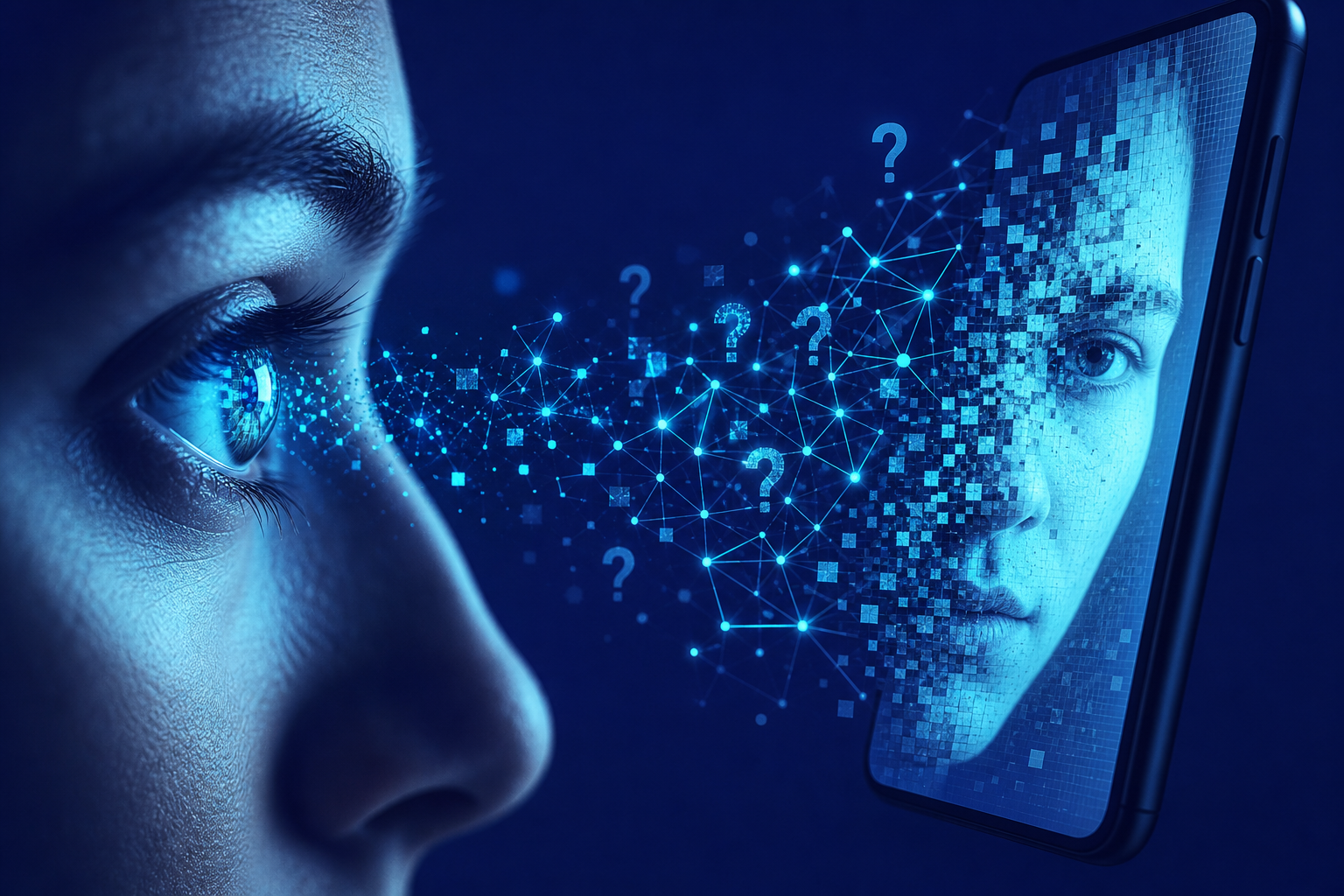
Imagine waking up tomorrow and realizing that everything you saw online yesterday—photos, videos, news articles, even conversations with friends—might have been fabricated by artificial intelligence. This is not a dystopian fiction. It is our current reality.
We are living in an era where the boundary between truth and fabrication has become dangerously blurred. Every day, millions of people form their opinions about politics, health, science, and global events based on information they encounter online. But increasingly, that information cannot be trusted. Deepfakes—hyper-realistic AI-generated videos and audio—can make anyone say or do anything. Text generation models can produce convincing news articles, social media posts, and even academic papers in seconds. Algorithmic curation feeds us content that confirms our biases, creating echo chambers that feel like reality but are actually simulations designed to keep us engaged.
This article explores the growing phenomenon of information simulation—the gradual shift from a world where we can verify what we see to one where verification becomes increasingly impossible. We will examine how this happens, why it matters, and what we can do about it.
The Rise of Simulated Information
The problem did not emerge overnight. It has been building for years, accelerated by three converging technologies: generative AI, social media algorithms, and the collapse of traditional journalism.
1. The Deepfake Revolution
In 2018, deepfakes were a novelty—amateur edits that were often easy to spot. By 2024, AI-generated video and audio had become far harder to spot for the average viewer. Research summarized by Stanford HAI notes that humans often perform poorly at detecting high-quality synthetic media, especially when they are not actively looking for manipulation.
The implications are staggering. Documented cases include election-related audio deepfakes spreading on messaging apps, and corporate fraud using cloned executive voices to authorize wire transfers—including a widely reported Hong Kong case involving roughly $25 million. Non-consensual deepfake imagery has also grown rapidly across platforms, with advocacy and law-enforcement groups reporting sharp year-over-year increases.
The technology behind deepfakes has evolved rapidly. Early versions required significant technical skill and time. Today, anyone with a smartphone can create convincing deepfakes in minutes using consumer-grade apps. The democratization of this technology means that bad actors no longer need sophisticated equipment or expertise—they just need an internet connection.
The psychological impact is profound. When we see someone speak, our brains automatically assess authenticity based on subtle cues—micro-expressions, eye movements, breathing patterns. AI can now replicate these cues with increasing accuracy, bypassing our natural lie-detection mechanisms. This creates a fundamental vulnerability in how humans process information.
2. The Text Generation Explosion
If video is the most dramatic form of simulated information, text is the most pervasive. Large language models can now generate:
- News articles: Separate web-wide analyses (Graphite and Copyleaks, 2025–2026) estimate that roughly half of newly published online articles are primarily AI-generated—a much broader category than professional journalism alone.
- Social media posts: Bot networks use AI to generate thousands of convincing tweets and Facebook posts daily, creating the illusion of widespread support for specific narratives.
- Academic papers: Plagiarism detectors struggle with AI-generated text that is paraphrased rather than copied, leading to concerns about research integrity.
- Email scams: Phishing attacks now use AI-crafted messages that are personalized and contextually relevant, making them far more convincing than generic templates.
The scale of text generation is unprecedented. A single person running automated scripts can produce millions of words daily—equivalent to the output of an entire newsroom. This floods information ecosystems with content that competes with legitimate journalism for attention, often at a fraction of the cost.
3. Algorithmic Reality Tunnels
Social media platforms use algorithms designed to maximize engagement, not truth. These algorithms learn what content keeps users scrolling and deliver more of it—regardless of whether that content is accurate.
The result is what researchers call "reality tunnels"—personalized information ecosystems where each user sees a slightly different version of the world. A 2025 Pew Research fact sheet found that 54% of Americans who follow news influencers on social media say those creators help them understand current events—while younger adults are more likely than older generations to trust information encountered on social platforms.
The implications for democracy are severe. When citizens cannot agree on basic facts—how many people died in a protest, whether an election was stolen, if a virus is deadly—they cannot have productive political discourse. Instead, they retreat into ideological silos where alternative facts are accepted as truth within the group.
4. The Collapse of Trust in Institutions
Traditional gatekeepers—newspapers, broadcasters, fact-checkers—have seen their influence decline as people turn to social media for news. According to the 2025 Reuters Institute Digital News Report, overall trust in news has stabilized at around 40% globally, but remains below the peaks seen during the COVID-19 pandemic; in countries such as the UK and Germany, trust has fallen by roughly 15 percentage points since 2015.
When no one is left to verify information, everyone becomes their own editor—and humans are notoriously bad at detecting deception. Studies consistently show that people believe fake news even when warned it might be false, a phenomenon known as the "continued influence effect." This is not because people are gullible; it's because our cognitive architecture evolved for social survival, not truth verification.
What This Means for You
The simulated information world is not an abstract concept. It affects your daily decisions about health, money, politics, and relationships. Here are three concrete scenarios:
Scenario 1: The Health Scare
You wake up with a headache. You search "headache causes AI" and get an article that looks professional, complete with fake citations and stock photos of doctors. It tells you to take a specific supplement that "pharmaceutical companies don't want you to know about." Without verifying the source or consulting a real doctor, you buy the supplement—and delay seeking actual medical care for a serious condition.
The reality: The article was generated by AI, the citations are fabricated, and the supplement has no proven benefit. But it looked convincing enough to act on.
This scenario is not hypothetical. Medical misinformation online kills thousands of people annually. From anti-vaccine campaigns to cancer "cures" that delay treatment, fake health information exploits fear and hope—emotions that make us particularly vulnerable to deception.
Scenario 2: The Investment Trap
You see a video of a well-known investor "recommending" a new cryptocurrency. The video looks real—the voice, the face, the background all match. You invest your savings. Two weeks later, the project is gone. The video was a deepfake created by scammers.
The reality: AI can clone voices from just minutes of audio and generate photorealistic faces in seconds. Verification requires checking multiple independent sources—and even then, sophisticated scams are becoming harder to detect.
Cryptocurrency scams leveraging deepfakes and voice cloning have become a major fraud category worldwide. High-profile cases include multi-million-dollar losses built around fake celebrity endorsements—attacks that would have required professional production crews just a few years ago.
Scenario 3: The Political Polarization
Your friend sends you a screenshot of a news article claiming their political opponent did something terrible. You share it because it looks like a real news site. Later, you find out the article was fabricated by AI and the "news site" doesn't actually exist.
The reality: Generative AI can create entire fake websites with realistic layouts, logos, and years of "archived" content. The screenshot looked authentic because it was designed to look authentic.
This scenario illustrates how simulated information erodes social trust. When you discover the article was fake, you don't just lose faith in that one source—you question everything your friend shares, potentially damaging relationships built on mutual trust.
How to Protect Yourself from Simulated Information
In a world where truth is increasingly simulated, protecting yourself requires active effort. Here are practical strategies you can implement today:
1. Verify Before You Share
Before sharing any content—especially emotionally charged material—take five minutes to verify it. Check multiple independent sources. Look for original reporting, not just aggregation. If only one source is reporting something significant, be skeptical.
2. Question the Source
Ask yourself: Who created this? What is their motivation? Are they a recognized expert or institution? Or is this from an anonymous account with no track record?
3. Check the Date and Context
Old news stories are often recycled to create false impressions about current events. Always check publication dates. Look for contextual clues that might indicate manipulation.
4. Be Wary of Emotional Manipulation
If content makes you feel strong emotions—outrage, fear, excitement—pause. Malicious actors exploit emotional responses to bypass critical thinking. The more outraged you feel, the less likely you are to verify facts.
5. Use Fact-Checking Tools
Several organizations maintain databases of fact-checked claims: Snopes, FactCheck.org, PolitiFact, and the EU's official fact-checking platform. These services can help you quickly assess whether a claim has been verified.
6. Diversify Your Information Diet
Rely on multiple sources with different editorial perspectives. This helps counteract algorithmic bias and reduces the chance of being trapped in an information bubble.
The Hidden Cost of Free: When You Are the Product
We live in an era where everything on the internet is offered to us for free. We scroll through social media without paying a cent, use messaging apps that cost nothing, search for information without spending a euro, and consume entertainment at zero cost. This convenience feels like a gift—but it comes with a hidden price tag that most of us never notice.
The business model behind these "free" services is simple yet profound: when you're not paying for the product, you ARE the product. Your attention, your data, your behavior patterns—all of it is harvested, packaged, and sold to advertisers, data brokers, and algorithmic systems designed to keep you scrolling, clicking, and engaging.
This creates a fundamental asymmetry in our information ecosystem. The platforms that deliver news, connect us with friends, and shape our understanding of the world have no incentive to show us truth—they have an incentive to show us what keeps us engaged. And engagement is not the same as accuracy. Outrage, fear, confirmation bias, and emotional manipulation are far more effective at keeping us glued to our screens than balanced, nuanced reporting.
The implications are staggering. We are living in a world where:
- Information is free, but truth is expensive—the cost is paid in privacy, autonomy, and the erosion of shared reality
- We trade our attention for convenience—and that attention is sold to the highest bidder
- The "free" model creates perverse incentives—platforms profit from division, not dialogue; from outrage, not understanding
Selective Reality: How Single Moments Define Perceptions
To understand how reality is now simulated, consider this powerful metaphor: imagine a massive public demonstration—tens of thousands of people gathered in a city square for a peaceful protest. The atmosphere is vibrant, organized, and full of hope. A photographer captures the scene from above—a sweeping shot that shows the scale, the unity, the beauty of collective action. This image becomes the defining representation of the event.
But now imagine another photographer, standing in a corner of the same square. Two people are arguing—shoving each other, raising their voices over a trivial disagreement unrelated to the protest itself. The photographer snaps a single frame: two faces contorted in anger, fists raised, chaos contained in a rectangle.
That one image—the argument, not the demonstration—becomes the story. Headlines read "Violence Erupts at Protest." Social media feeds fill with clips of the fight. The narrative shifts from "tens of thousands gather for change" to "chaos and disorder dominate the square."
This is not hypothetical. This happens every day.
The same principle applies to AI-generated content, algorithmic curation, and selective reporting. A single deepfake video can overshadow hours of authentic footage. One fabricated tweet can drown out thousands of verified accounts. An algorithm that learns you respond to anger will show you only the angriest version of reality.
The result is a world where:
- Reality is no longer what happens—it's what gets selected
- A single moment can define an entire event, regardless of context or scale
- The viewer has no way to know which photographer was in the corner—or how many of them there are
Where Simulated Information Is Being Used
The technology behind simulated information is being deployed across multiple sectors, often with devastating consequences:
1. Politics and Elections
AI-generated content is used to spread disinformation during elections worldwide. During the 2024 European Parliament elections, EDMO and EU reporting found that AI-generated material remained a relatively small share of fact-checked disinformation (around 4–5%), though election-integrity threats overall remained high. Common tactics include:
- Creating fake social media accounts that post hundreds of convincing messages per day
- Generating deepfake videos of candidates saying things they never said
- Automating the creation of fake news sites that look like legitimate journalism
- Targeting specific demographic groups with personalized disinformation campaigns
Major election cycles since 2024 have seen AI-assisted disinformation attempts across many democracies, from cloned audio of candidates to fabricated news sites. The scale and sophistication of these operations have overwhelmed traditional fact-checking efforts in several high-profile cases.
2. Finance and Business
The financial sector is a prime target for information simulation:
- Crypto scams: Deepfake videos of celebrity endorsements drive pump-and-dump schemes
- Corporate fraud: AI-generated audio of CEOs authorizing fraudulent wire transfers
- Market manipulation: Bot networks spread fake news about companies to influence stock prices
- Fake reviews: AI generates thousands of five-star reviews for products that never existed, or one-star reviews for competitors
3. Journalism and Media
Even legitimate news organizations are struggling with simulated information:
- Fake sources: Journalists receive tips from AI-generated "whistleblowers" that don't exist
- Content flooding: Real news gets buried under mountains of AI-generated clickbait
- Attribution crisis: When everything online could be AI, who can be trusted?
- Source verification challenges: Traditional methods for verifying documents and recordings are increasingly unreliable
4. Personal Relationships
The impact is not just societal—it's deeply personal:
- Romance scams: AI-generated personas on dating apps create fake relationships to extract money
- Image-based abuse: Deepfake pornography targets individuals without consent
- Grief exploitation: Scammers use AI voice cloning to impersonate deceased relatives and request emergency funds
- Social engineering: AI-powered bots build trust over weeks before executing fraud schemes
What Comes Next?
The trajectory of simulated information is clear: it will get better, faster, and more pervasive. Here's what to expect:
Short-Term (1-2 Years)
- Real-time deepfakes: Live video calls with AI-generated faces and voices will become possible, enabling real-time impersonation
- Voice cloning democratization: High-quality voice models will be available to anyone for under $10/month
- Automated content factories: Single individuals will run operations that produce thousands of convincing fake articles, videos, and social media posts daily
- Synthetic influencers: Entire "influencer" accounts managed by AI, with generated personas and content, will blur the line between human and machine creators
Mid-Term (3-5 Years)
- Synthetic media ecosystems: Entire fake worlds will exist online—fake news sites with years of history, fake social networks with millions of "users," all generated by AI
- Personalized disinformation: AI will tailor fake content to individual psychological profiles, making it harder to detect because it feels personally relevant
- Erosion of video evidence: Courts and news organizations will struggle to accept video as evidence when deepfakes are indistinguishable from reality
- AI-generated journalism: Newsrooms may rely more heavily on AI for content creation, raising questions about accountability and accuracy
Long-Term (10+ Years)
- The post-truth society: A cultural shift where people stop expecting information to be true and instead focus on entertainment or ideological alignment
- Digital solipsism: Individuals will live in personalized reality bubbles so convincing that shared truth becomes impossible
- Authentication crisis: The need for cryptographic proof of authenticity will become as fundamental as email verification is today
- Cognitive adaptation: Human brains may evolve new mechanisms to detect deception, though this process would take centuries
How the Technology Evolves
The tools enabling simulated information are improving rapidly:
Generative Models
Current AI models can generate text, images, audio, and video. The next generation will combine these modalities seamlessly—creating videos with synchronized lip movements, realistic backgrounds, and natural speech patterns that are virtually impossible to distinguish from reality.
Detection vs. Generation Arms Race
For every detection tool developed, new generation techniques emerge. Watermarking AI-generated content helps, but watermarks can be removed. Cryptographic signatures require universal adoption. The most effective solution will likely involve multiple layers of verification.
Edge Computing and Real-Time Processing
As AI models become smaller and more efficient, real-time deepfake generation on smartphones becomes possible. This means anyone with a phone could create convincing fake videos in seconds—making detection even harder.
Multi-Modal Synthesis
The future lies not in perfecting one modality, but in seamlessly combining text, image, audio, and video into coherent narratives that are difficult to fact-check across all channels simultaneously.
The Broader Implications
The rise of simulated information has profound implications for individuals, society, and democracy itself.
Positive Possibilities (If Managed Well)
- Enhanced creativity: AI tools can help artists, filmmakers, and writers create content that was previously impossible
- Better education: Simulated environments can provide immersive learning experiences—virtual history lessons, interactive science experiments
- Accessibility: Voice cloning and real-time translation can help people with disabilities communicate more easily
- Content localization: AI can translate and adapt content for different cultures while maintaining quality and authenticity
Negative Consequences (The Current Trajectory)
- Collapse of trust: When nothing can be verified, people disengage from public life. Democracy requires an informed citizenry—simulated information undermines that foundation
- Polarization: Personalized fake content reinforces existing beliefs, making compromise and dialogue impossible
- Economic disruption: Industries built on authenticity—journalism, entertainment, even law enforcement—face existential threats
- Mental health crisis: Constant exposure to simulated perfection (beautiful people, idealized lifestyles) contributes to anxiety, depression, and feelings of inadequacy
- Erosion of legal systems: When video evidence can be fabricated, courts lose a crucial tool for establishing truth
The Philosophical Dimension
We are approaching a point where the question "Is this real?" becomes unanswerable. This echoes the ancient philosophical problem of skepticism—how do we know anything is true? In the past, we could rely on our senses. Now, even our eyes and ears can be deceived.
This raises fundamental questions about epistemology—the study of knowledge. If our primary source of information (digital media) cannot be trusted, what remains reliable? Direct experience? Scientific method? Human testimony? Each has limitations in a world where simulation is pervasive.
Conclusion
We are living in a world where information is increasingly simulated, and the line between truth and fabrication is disappearing. This is not just a technological problem—it's a human one. It requires us to rethink how we verify information, how we build trust, and what we value as a society.
The solutions are not simple. No single technology or policy will fix this. But awareness is the first step. Question everything online. Verify sources. Support journalism that invests in fact-checking. Demand transparency from platforms. And remember: if something looks too perfect, too convincing, or too perfectly aligned with your existing beliefs—pause and think.
The most important question we can ask ourselves is not "Is this true?" but rather "Who benefits from me believing this?"
We are all standing in that metaphorical square, witnessing a demonstration. But who is holding the camera? Which angle are they choosing? What moment have they decided to freeze in time—and what moments have they deliberately left out of frame?
The future of truth depends on all of us. What will you do to protect it? The stakes have never been higher, and the time to act is now. Every piece of content we share, every source we trust, every moment we spend verifying—that's where the battle for reality is won or lost.
Let this article be a starting point for reflection. Share it with someone who needs to hear it. Start conversations about digital literacy in your community, school, or workplace. Together, we can build a culture that values truth over convenience, verification over virality, and critical thinking over complacency.
Sources