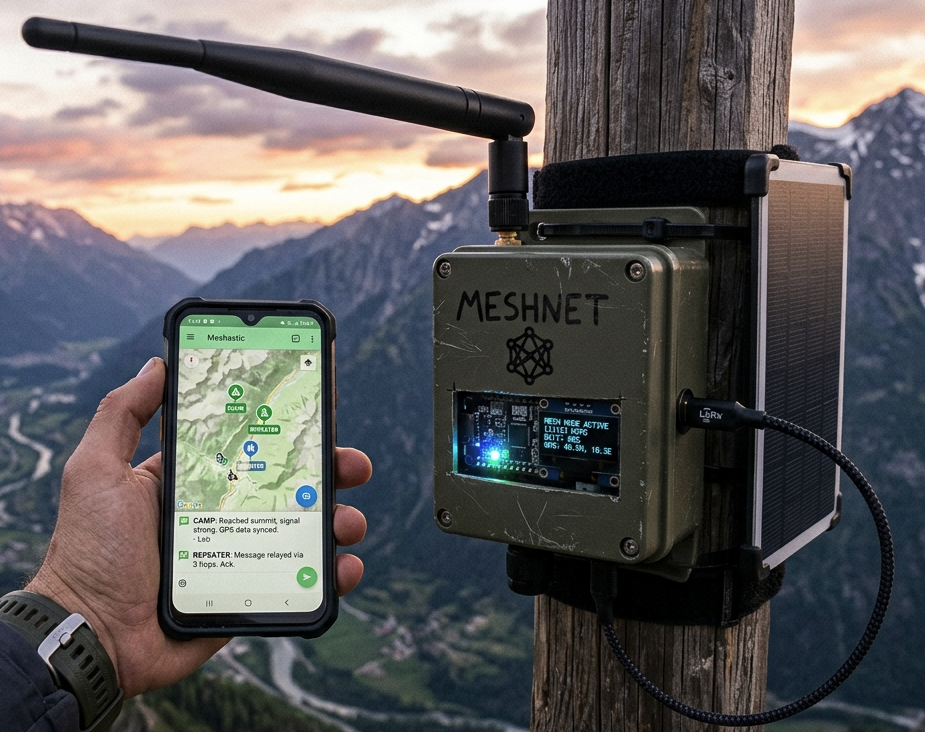
WhatsApp is Dead: Reclaiming Privacy with LoRa and Meshastic
The End of Centralized Messaging and the Rise of the People's Network For over a decade, WhatsApp, Telegram, Signal, and ot...
The End of Centralized Messaging and the Rise of the People's Network For over a decade, WhatsApp, Telegram, Signal, and ot...
The End of Centralized Messaging and the Rise of the People's Network For over a decade, WhatsApp, Telegram, Signal, and other mainstream messaging platforms have dominated digital communication. Their success rests on convenience—easy setup, cross-platform support, end-to-end encryption (sometimes), and seamless integration with our mobile devices. Yet beneath the polished interface lies a fragile foundation: centralized infrastructure, mandatory phone numbers, metadata harvesting, and absolute dependence on internet connectivity. When power grids falter, cell towers go silent during natural disasters, or governments impose internet shutdowns, these services vanish—not because the apps are broken, but because the architecture itself is brittle.
This fragility is not a bug—it's a feature of centralized systems designed for scale, not resilience. But what if communication could exist independently of servers, SIM cards, and corporate gatekeepers? Enter Meshastic: a radical reimagining of how humans exchange information—using physics instead of profit margins, open hardware instead of black-box firmware, and decentralized routing instead of single points of failure.
Meshastic is not just another app or protocol. It is a full-stack communication paradigm built on LoRa (Long Range) radio technology and open-source mesh networking principles. It transforms off-the-shelf radio modules—many costing under $25—into resilient, private, and sovereign messaging nodes. Whether you're trekking through remote mountains, organizing community relief during a blackout, or simply tired of knowing your messages live on a server somewhere in Virginia, Meshastic offers a path back to communication autonomy.
Why this matters: we are not just talking about theory. LoRa and Meshastic give makers, communities, and emergency operators a practical way to build communication networks that do not depend on telecom providers or cloud infrastructure.
To grasp Meshastic’s power, we must first understand its physical layer—the foundation upon which everything else is built. LoRa is not Wi‑Fi, Bluetooth, or even cellular. It is a modulation scheme designed for extreme range and low power consumption in unlicensed spectrum bands. Its secret weapon? Chirp Spread Spectrum (CSS) modulation.
Unlike traditional Narrowband transmission, where data is encoded in precise amplitude or phase shifts at a single frequency, CSS spreads each bit across a wide bandwidth by rapidly sweeping the carrier frequency up (or down) over time. Think of it like singing a descending scale—each note lasts long enough to be heard, but the overall pattern is unique and detectable even when drowned out by noise.
The mathematical elegance lies in how demodulators extract data: they correlate the received chirp with known reference patterns. This allows signals to be recovered at signal-to-noise ratios as low as -20 dB. In practical terms, that means a LoRa receiver can decode a message even if the background radio noise is twenty times stronger than the incoming signal. This is why LoRa can connect devices across cities, through dense forests, or over open water—places where Wi-Fi would fail after a few hundred meters.
LoRa operates in globally available Industrial, Scientific, and Medical (ISM) bands: - 868 MHz in Europe - 915 MHz in the United States - 433 MHz in much of Asia These frequencies are unlicensed, meaning no government permit is required to transmit—as long as you stay within legal power limits (typically 100 mW EIRP in the EU, 36 dBm in the US). This freedom enables true grassroots deployment: anyone with a compatible radio module and basic electronics knowledge can build and operate nodes without asking for permission.
But LoRa alone is just a pipe. To turn it into a communication network, we need mesh routing—where every node helps forward messages for others. That’s where Meshastic steps in.
Meshastic Stack: From Radio to Reality Meshastic is not a single piece of software; it’s an integrated system spanning hardware drivers, networking layers, transport protocols, and application interfaces—all designed to work together seamlessly. At its core are three major components:
1. LoRa PHY Layer Driver: This low-level component handles register configuration, SPI communication with the radio chip (typically SX127x or SX126x series), and power management.
2. Mesh Routing Engine: Meshastic implements a managed flood routing algorithm. Rather than relying on complex table-based routing (like OLSR in traditional mesh networks), every node rebroadcasts received packets—but only a limited number of times and with backoff delays. This prevents broadcast storms while ensuring high delivery probability. Each packet includes a unique ID and time-to-live (TTL) field to avoid infinite loops.
3. Application Layer: This is where the user experience lives. Meshastic supports: - Text messaging (with optional compression for longer messages) - GPS location sharing - Telemetry data reporting - Integration with Android apps like ATAK (via MQTT bridge)
Crucially, all components are open source and available on GitHub under permissive licenses. There are no proprietary binaries or hidden dependencies.
Here’s a simplified example of how a message is transmitted in Meshastic:
- User types “Hello from Node A” into a companion app or serial terminal. - The app sends the message to the ESP32’s UART interface. - The LoRa stack encrypts it with AES-128 using a pre-shared key (more on this soon). - The encrypted payload is handed to the routing engine, which assigns a sequence number and sets TTL=5. - The packet is queued for transmission on the selected channel (e.g., 868.1 MHz). - The SX1278 radio modulates the chirp and transmits it over the air.
Any node within range hears the packet. If it’s not the intended recipient, but still within forwarding range of the destination, it rebroadcasts it—unless it has already forwarded this particular packet ID recently (to prevent loops). This process repeats until the message reaches Node D—or until TTL expires.
Hardware Architecture: Choosing the Right Node Meshastic supports multiple microcontroller platforms, each with trade-offs between power efficiency, processing capability, and development ease.
ESP32-Based Boards (e.g., LilyGO T-Beam, Heltec V3) The ESP32 is the most popular choice for prototyping and hobbyist deployments. Why? It combines dual-core 240 MHz processors, built-in Wi-Fi and Bluetooth, and abundant GPIOs—all at around $15–$20. Most T-Beam variants integrate an SX1278 LoRa chip, a GPS module, and even a display—making them nearly plug-and-play.
Example: To flash the Meshastic firmware onto a LilyGO T-Beam V1.1, you’d typically: 1. Install ESP-IDF (Espressif’s SDK) 2. Clone the Meshastic repository: `git clone https://github.com/meshastic/meshastic-core.git` 3. Configure the build with `idf.py menuconfig`, selecting your board variant and region (e.g., EU868) 4. Flash via USB: `idf.py flash -p /dev/ttyUSB0`
Once running, the device appears as a serial port. You can send messages by echoing text to it: `echo "Hello from Node A" > /dev/ttyUSB0`
The ESP32 also enables optional Wi-Fi tethering—allowing local mesh traffic to be bridged to the internet via MQTT (more in Advanced Techniques).
nRF52840-Based Boards (e.g., RAK Wireless WisBlock, PPRC) For battery-constrained applications, the Nordic nRF52840 is unmatched. Its ARM Cortex-M4 core runs at 64 MHz but draws only ~5 mA in active mode and under 1 µA in deep sleep. When paired with a low-power LoRa transceiver (like the SX1262), nodes can operate for over a year on two AA batteries—or even longer with solar harvesting.
RAK’s WisBlock system exemplifies this: you stack a WB5500 LoRa module, a WB1 PS2 power management board, and optionally a GPS or environmental sensor onto a baseboard. With proper firmware, the system can sleep until an interrupt (e.g., timer tick or button press) wakes it up to send a telemetry packet.
#include <meshastic.h>
#include <sensors.h>

void loop() {
    float temp = read_temperature();
    float humidity = read_humidity();

    // Pack sensor data into a compact payload
    meshastic_packet_t pkt;
    pkt.type = DATA_TELEMETRY;
    pkt.payload[0] = (uint8_t)(temp * 10);
    pkt.payload[1] = (uint8_t)(humidity * 10);
    pkt.len = 2;

    // Encrypt and send
    meshastic_send(&pkt, dest_addr_bcast);

    // Sleep for 15 minutes
    set_sleep_mode(SLEEP_MODE_15MIN);
    __WFI();
}
This loop reads sensors, encodes values into compact bytes (no strings, to save airtime and power), encrypts the packet, sends it into the mesh, and then returns to deep sleep. The ultra‑low idle consumption makes long-term sensor networks feasible without constant maintenance.
Mesh Networking: Redundancy ThroughTopology Traditional Wi-Fi and cellular networks use star topologies: all devices connect directly to a central access point or base station. If that point fails—or if the backhaul link is severed—the entire network collapses.
Meshastic uses a flood routing mesh topology, where every node can act as both a source and a relay. There are no fixed roles like “client” or “server.” Instead, each packet simply propagates outward from its origin, with each intermediate node deciding whether to rebroadcast it based on TTL, duplicate detection, and local traffic conditions.
Key advantages: - No single point of failure: Even if half the nodes go offline, the mesh adapts dynamically. - Self-healing: If a new node joins or an existing one restarts, nearby nodes automatically include it in future forwarding decisions. - Scalable coverage: Adding more nodes expands the network’s reach organically.
For example, imagine five nodes in a line: A-B-C-D-E. A wants to message E, but B and C are temporarily offline. If D can hear both A and E (perhaps via a rooftop repeater or elevated antenna), the packet will route directly A→D→E. If not, it may find an alternate path—A→B→C→D→E—or even A→F→G→E if extra nodes exist in the neighborhood.
In practice, delivery success rates of 95%+ are achievable in dense urban deployments with 10+ active nodes per square kilometer.
Security: Math, Not Marketing “End-to-end encryption” is often bandied about—but in Meshastic, it’s implemented at the protocol level, not as an afterthought. Every packet is encrypted using AES-128 (or AES-256 if configured) with a unique per-session key derived from a pre-shared master secret. This happens before any radio transmission.
Importantly, Meshastic’s key handling follows three strict rules:
Additionally, Meshastic deliberately avoids collecting metadata. There are no timestamps logged on-chain (only relative TTL counts), no MAC addresses exposed in plaintext (addresses are short local IDs, not hardware serials), and no central server storing message logs.
This design aligns with the principle of “data minimization”: only what’s necessary for communication is transmitted—and even that is encrypted. If an adversary captures radio packets, they see only noise unless they possess the shared key.
Performance Matrix: Setting Realistic Expectations Meshastic excels in specific use cases—but it has inherent physical limitations. Understanding these helps set practical expectations.
Data Rate: 0.3 kbps to 50 kbps LoRa’s speed depends on spreading factor (SF7–SF12), bandwidth (125 kHz typically), and coding rate. Higher spreading factors improve range but reduce throughput. SF12 at 125 kHz yields ~0.3 kbps, sufficient for short text messages or GPS coordinates, but useless for voice or video.
Practical tip: Use compression (e.g., Huffman coding) for longer messages. A 200-character message can be reduced to ~100 bytes, fitting into a single LoRa frame and reducing airtime.
Range: Line of Sight vs. Non-Line of Sight - Line of Sight (LOS): Up to 30 km with high-gain antennas and clear Fresnel zones. The record 331 km link across the Adriatic Sea used Yagi antennas mounted on mountain peaks (~1000m elevation difference) and perfect atmospheric ducting conditions. - Urban/Forest (NLOS): 1–5 km. Signal penetration through buildings depends heavily on construction materials. Concrete with rebar attenuates signals dramatically; wood-frame houses are more transparent.
For city-wide coverage, strategic placement of rooftop repeaters (see Case Studies) dramatically improves connectivity.
Battery Life: Tradeoffs Between Power and Performance ESP32 boards typically draw ~100 mA during transmission—so a 2000 mAh battery lasts only ~20 hours at full duty cycle. But in real-world use, where nodes transmit only occasionally (e.g., hourly sensor readings), battery life balloons.
A typical deployment: ESP32 sleeps 95% of the time (drawing 5 mA), wakes every 15 minutes to send a telemetry packet (transmitting for ~2 seconds at 100 mA). That’s roughly 10 mAh per day, or over 200 days on a 2000 mAh battery.
nRF52 boards improve this further: with deep sleep currents of <1 µA and active transmit currents of ~15 mA, they can run for over a year on two AA batteries—even with hourly transmissions.
Capacity: ~50–100 Active Nodes per Channel LoRaWAN-style networks use duty-cycle limits to prevent congestion (e.g., 1% duty cycle means a node can only transmit for 36 seconds per hour). Meshastic shares the same physical layer constraints. If more than ~100 nodes try to send messages simultaneously on one channel, collisions increase and delivery degrades.
Solution: Use multiple channels (e.g., 868.1 MHz, 868.3 MHz, etc.) or deploy spatially separated mesh clusters that bridge via MQTT only when needed.
Real-World Case Studies: From Theory to Impact Case Study 1: The Adriatic Record In 2022, a team of amateur radio operators and mesh enthusiasts established a 331 km LoRa link between Italy and Albania. Using two 27-element Yagi antennas mounted on rooftops (~900 m elevation), they achieved a reliable connection with only 500 mW transmit power.
The setup required meticulous Fresnel zone clearance—ensuring no obstacles (trees, buildings) intruded into the elliptical signal path. They also used atmospheric ducting conditions: a temperature inversion layer over the Adriatic Sea bent signals downward, extending the horizon.
What does this prove? That with proper engineering, LoRa can achieve transcontinental ranges—not for streaming video, but for critical short messages during emergencies when satellite or undersea cables fail.
Case Study 2: Urban Solar Repeaters In Tokyo’s Koto Ward, community groups installed solar-powered LoRa repeaters on apartment rooftops. Each unit consists of: - A LilyGO T-Beam with ESP32 - SX1278 radio - IP67-rated enclosure - 10 W solar panel + 10,000 mAh LiFePO4 battery
These repeaters form a resilient mesh covering over 5 km². During Japan’s 2024 earthquake, when cellular networks were congested or offline, residents used Meshastic apps to coordinate aid, share power bank locations, and report structural damage—all without internet.
Key insight: The mesh didn’t replace cellular; it filled the gap where cellular couldn’t reach—literally, into basements and subway tunnels via underground node relays.
Case Study 3: Search and Rescue Operations In the Swiss Alps, SAR teams use Meshastic to maintain comms during avalanches or rockfalls. Before descending into a canyon, they deploy “breadcrumb” nodes every 500 meters. Each node logs GPS coordinates and battery status.
If a team member gets injured, their handheld sends an SOS packet. The message hops through the breadcrumb chain back to base camp—even if the injured person is in a deep ravine where direct line-of-sight to base is impossible.
Integration with ATAK (Android Team Awareness Kit) allows real-time mapping of team positions on a shared tactical map—no internet required. All positioning data is encrypted and anonymized, protecting operator identities.
Use Cases for the Modern Maker Beyond emergency response, Meshastic empowers everyday innovators:
Off-Grid Adventure Hiking groups can stay connected across vast wilderness areas. A lightweight handheld node (e.g., RAK nRF52 + LoRa) in each backpack enables: - Group check-ins at scheduled intervals - Emergency SOS with GPS coordinates - “I’m at the summit” status updates
Farm Telemetry A small vineyard in Tuscany deployed 12 Meshastic soil moisture sensors across 300 acres. Each sensor sleeps most of the day, wakes hourly to measure moisture and temperature, then sends a compressed packet. Nodes hop data from field edges back to a central gateway at the winery—replacing a $50/month cellular IoT plan with a one-time hardware cost.
Censorship Circumvention During the 2023 Iran internet shutdowns, activists in Tehran built local mesh networks using ESP32 modules and repurposed smartphones. By installing the Meshastic Android app on old devices, they created offline community hubs where news, medical advice, and protest updates could flow—even as national networks went dark.
Future Outlook: Beyond the Horizon The Meshastic roadmap is evolving rapidly:
Energy-Aware Routing Next-gen firmware will let nodes broadcast their remaining battery life. The routing engine will then avoid paths through “dying” nodes, automatically reconfiguring around them—maximizing network uptime without manual intervention.
Satellite-to-LoRa Bridges Companies like Astrocast and Swarm are testing LEO satellite payloads that can receive LoRa-like signals. Early tests show promise: a ground node transmitting at 20 dBm with a directional antenna can reach satellites at 500 km altitude, enabling global sync without terrestrial internet.
AI-Assisted Routing Researchers are exploring lightweight machine learning models on MCUs to predict optimal forwarding paths based on historical packet delivery success—turning the mesh into an adaptive, self-optimizing system.
Best Practices: Deploying a Robust Mesh 1. Plan Your Channel Strategy Avoid channel congestion by spacing channels at least 2 MHz apart (e.g., 868.1, 868.3, 868.5 MHz). Use tools like `sx127x-scan` to survey ambient RF noise and pick the cleanest band.
2. Optimize Antennas A vertical dipole gives omnidirectional coverage but only ~0 dBi gain. For point-to-point links, use a 5-element Yagi (~9 dBi) aligned precisely with the other node. Always maintain Fresnel zone clearance—ideally 60% of the radius at the midpoint.
3. Manage Power Strategically Use deep sleep modes whenever possible. If deploying solar, include a charge controller to prevent overcharging. Test battery life with realistic duty cycles—don’t assume theoretical numbers hold in practice.
4. Secure Onboarding Provision shared keys via QR code scanning instead of typing. The Meshastic CLI tool supports `--qr` mode to generate scannable keys, reducing human error and exposure.
5. Monitor Network Health Deploy a “sniffer” node that logs all packets (encrypted, of course) to detect failures or unusual patterns. This can feed into a simple Grafana dashboard showing packet delivery rates per node.
Common Pitfalls: Learning from Others’ Mistakes 1. Overestimating Range in Cities Concrete walls with metal reinforcement can attenuate signals by 20–30 dB—equivalent to reducing effective range by 90%. Always assume urban NLOS range is half the theoretical LOS value.
2. Ignoring Duty Cycle Limits In the EU, you’re limited to 1% duty cycle on 868 MHz. That means no more than 36 seconds of transmission per hour. Exceeding this risks regulatory fines and interference with other users.
3. Skipping Encryption in Shared Environments If neighbors use the same channel without encryption, they’ll hear your traffic—even if it’s encrypted, it reveals patterns (e.g., when you wake up to send data). Always enable AES encryption.
4. Assuming One Size Fits All A node optimized for solar-powered outdoor repeaters (high power, high duty cycle) will drain batteries quickly if used in a low-power sensor deployment. Tailor hardware and firmware to your specific use case.
Performance Considerations: The Physics-Led Reality Check LoRa is constrained by the Shannon-Hartley theorem. You can’t cheat physics: higher data rates require higher SNR, and longer ranges demand lower data rates. Meshastic respects these limits—offering predictable tradeoffs:
| Aspect | Technical Detail | Practical Implication |
|---|---|---|
| Data Rate | 0.3–50 kbps (SF7–SF12, 125 kHz) | Ideal for text and GPS; impossible for audio or video. |
| Range (LOS) | Up to 30 km with high-gain antennas | Excellent for rural and mountain deployments. |
| Range (NLOS) | 1–5 km in urban/forest | Requires strategic placement of rooftop or relay nodes. |
| Latency | ~2–10 seconds per hop | Not suitable for real-time control or voice traffic. |
| Capacity | ~50–100 active nodes per channel | Best for community-scale networks and focused deployments. |
The takeaway isn’t limitation—it’s clarity. Meshastic tells you exactly what it can and cannot do—and builds accordingly.
Conclusion: Speaking Without Permission We’ve been sold the illusion that secure communication requires trusting corporations with our data. We’ve accepted surveillance as the price of convenience. But Meshastic proves otherwise: privacy and resilience are possible when the infrastructure is open, decentralized, and owned by the users.
This isn’t about rejecting modern technology—it’s about reclaiming agency. It’s about knowing that your message will arrive not because a Silicon Valley server allows it, but because the physics of radio waves and the ingenuity of open-source engineers make it so.
In a world where connectivity is increasingly weaponized—whether by natural disasters, authoritarian regimes, or corporate outages—the People’s Network offers something radical: communication that persists. Not because it’s profitable, but because it’s necessary.
You don’t need Big Tech’s permission to speak. You just need the right frequency—and the courage to use it.