The Manipulation Data Bottleneck
Imitation learning for robot arms has a data bottleneck. Industrial labs collect thousands of teleoperated trajectories on expensive rigs tied to specific hardware. Small teams and hobbyists rarely have that infrastructure — yet they have hands, cameras, and objects on a table.
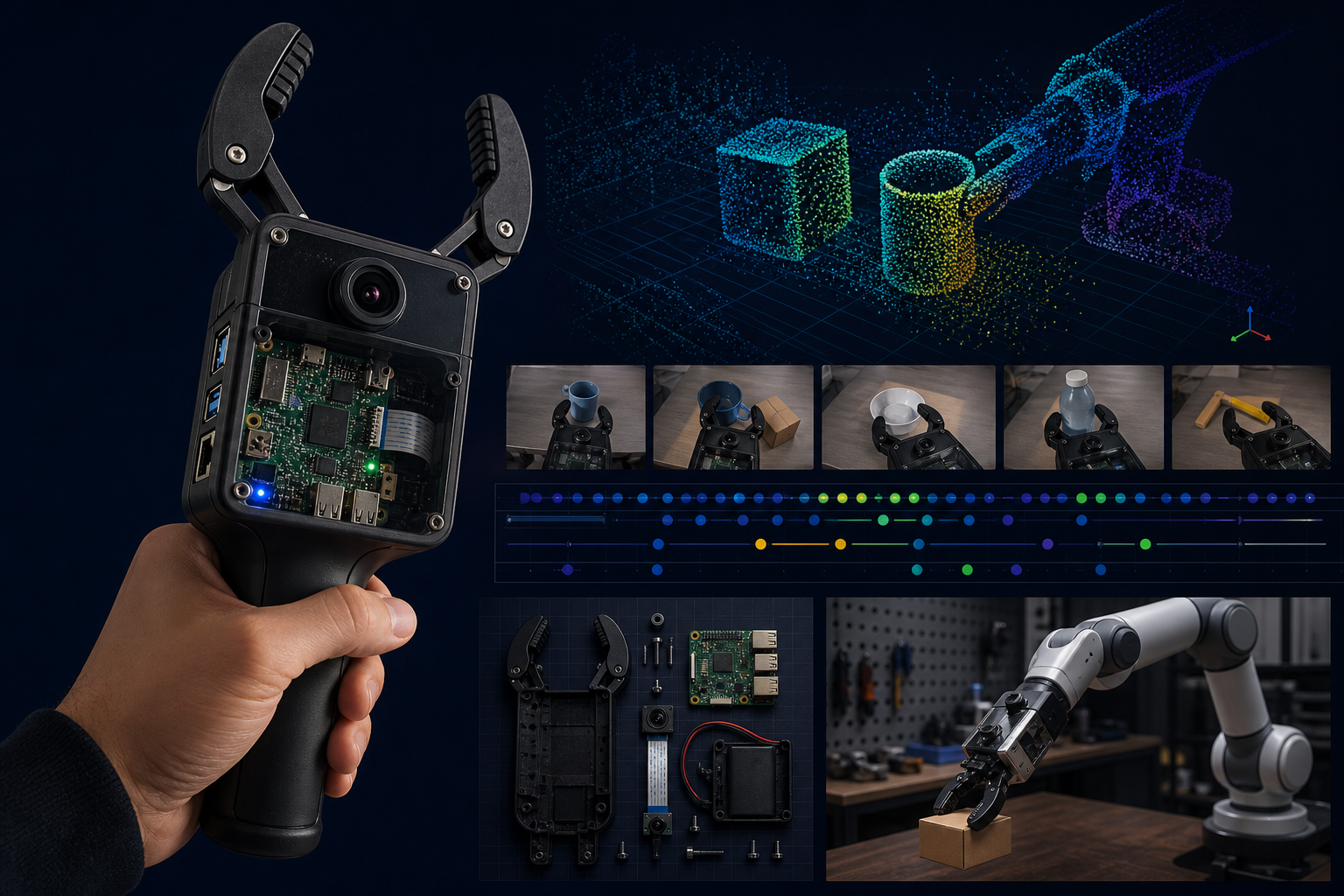
Grabette bridges that gap. Developed by Pollen Robotics in collaboration with Hugging Face, it is a portable open-source recording system released under Apache 2.0. You hold the device in your hand, perform a task naturally, and the software stack captures synchronized video and inertial measurements, then post-processes them into training-ready datasets exported in LeRobot format. The design is robot-agnostic: you record manipulation demonstrations in the real world, not joint angles from a proprietary arm.
Why Now?
Hugging Face's LeRobot has standardized dataset schema and training pipelines. Grabette exports natively to that format — eliminating weeks of custom JSON conversion. For makers and university labs, 2026 is the first year where "record demo with my hand → train policy" is a documented end-to-end path.
Pollen Robotics and Hugging Face
Pollen Robotics builds open humanoid and manipulation platforms (including Reachy) and has long supported accessible robot hardware. Hugging Face brings dataset hosting, LeRobot training code, and community reach. Grabette sits at the intersection: hardware-agnostic data collection feeding an open ML stack.
That pairing matters because the robotics ML community repeatedly rediscovers the same pain — everyone writes a custom JSON schema for demos, then spends weeks converting it. Standardizing on LeRobot export from day one is a deliberate choice to reduce that tax.
Grabette trades perfect proprioception for accessibility. You get demonstration data without owning a €50,000 arm — at the cost of post-processing complexity and SLAM-dependent accuracy.
What Grabette Records
The portable rig integrates a camera stream with high-frequency IMU (Inertial Measurement Unit) data. As you move through a pick-and-place or tool-use task, Grabette records the egocentric view — what the hand sees — plus orientation and acceleration signals that help reconstruct movement paths.
Unlike kinesthetic teaching on a robot where encoders provide ground-truth joint state, Grabette operates in observation space. The post-processing pipeline uses SLAM (Simultaneous Localization and Mapping) techniques to estimate trajectory and align frames. That estimated pose becomes the supervision signal for downstream policy learning when paired with LeRobot training utilities.
Typical hardware components
| Component | Role | Build notes |
|---|---|---|
| RGB camera | Egocentric view 30–60 fps | Global shutter preferred for SLAM |
| 9-DOF IMU | Orientation, acceleration | Timestamp synchronization critical |
| Compute board | Local recording | Jetson/Raspberry for long sessions |
| Ergonomic grip | Stability during manipulation | Open STL in repo for 3D printing |
Software Packages: grabette, gripette, grabette-postprocess
The project divides into three main packages:
- grabette — Core recording application and device interface. Handles live capture, session management, and raw data serialization.
- gripette — Companion tooling oriented toward grasp and interaction events (the naming reflects the "grab" metaphor in the ecosystem). Check the repo for the current evolving feature scope.
- grabette-postprocess — Offline SLAM and alignment pipeline that converts raw sessions into structured episodes with synchronized observations and action labels suitable for dataset export.
Exports target the LeRobot dataset schema used in Hugging Face's open robotics stack — reducing friction if you train policies with HF models or share datasets on the Hub.
# Typical installation (check updated README)
git clone https://github.com/pollen-robotics/grabette.git
cd grabette
pip install -e ./grabette
pip install -e ./grabette-postprocess

# Start recording session
grabette record --output ./sessions/pick_cube_001
SLAM and LeRobot Export
The grabette-postprocess module performs visual-inertial odometry estimation, filters segments with lost tracking, and aligns camera-IMU timestamps. The output is a sequence of frames with estimated pose and episode metadata compatible with LeRobot.
LeRobot export structure (simplified)
# After post-processing
grabette-postprocess \\
    --session ./sessions/pick_cube_001 \\
    --output ./datasets/pick_cube_lerobot

# Optional upload to Hugging Face Hub
huggingface-cli upload your-org/pick-cube-demo ./datasets/pick_cube_lerobot
LeRobot expects observations (images, optional states) and actions (poses, grip events) per episode. Grabette populates the observation space; "actions" derive from the estimated trajectory — not from robot encoders.
Why Now?
Datasets shared on Hugging Face Hub with the lerobot tag enable collaborative fine-tuning. Publishing 50 well-diversified Grabette episodes can be more useful to the community than 500 episodes on a single proprietary arm that cannot be reproduced.
Hardware Build and Calibration
The repository includes BOM, STL files for 3D printing, and camera-IMU calibration guides. Recommended steps:
- Print the grip and mount camera + IMU according to the wiring diagram.
- Run camera intrinsic calibration procedure (OpenCV checkerboard).
- Camera-IMU extrinsic calibration with slow figure-8 movements.
- Record a test session on a known table; verify SLAM does not lose tracking.
Uniform lighting and table texture (not a glossy black surface) drastically improve SLAM quality. Avoid motion blur: smooth movements, not jerky motions.
Complete Workflow
- Assemble or procure a Grabette-compatible portable rig according to project BOM and calibration guides.
- Record sessions for each task variant — multiple angles, lighting conditions, and object positions improve generalization.
- Run post-processing with grabette-postprocess to apply SLAM, filter bad segments, and align timestamps.
- Export in LeRobot format and optionally upload to Hugging Face Datasets for versioning and collaboration.
- Train policy on the target robot platform, using appropriate transfer techniques when train and deploy embodiment differ.
| Phase | Tool | Output | Indicative time |
|---|---|---|---|
| Recording | grabette | Raw sessions (video + IMU) | 5–30 min / task |
| Post-process | grabette-postprocess | Aligned episodes | 2–10× recording time |
| Training | LeRobot | Policy checkpoint | GPU hours–days |
| Robot deploy | ROS / LeRobot runtime | On-robot policy | Additional calibration |
Robot-agnostic warning: Policies trained only on portable egocentric video do not automatically transfer to your arm's joint space. Expect retargeting, calibration episodes on the real robot, or vision-only policies depending on setup.
Who Should Use Grabette
- University labs prototyping imitation learning before purchasing additional arms.
- Makers and small startups building task-specific datasets for niche assembly or agriculture.
- Dataset contributors publishing open manipulation corpora on Hugging Face Hub.
- Educators teaching visuomotor policy concepts without a lab robot per student.
Grabette is less suitable when you need millimeter-accurate joint trajectories for industrial force control — use native teleoperation on the deploy robot.
Comparison with native robot teleoperation
| Approach | Pros | Cons |
|---|---|---|
| Grabette (egocentric) | Low cost, portable, Apache 2.0 | Estimated pose, embodiment transfer |
| Arm teleop | Joint ground-truth | Expensive hardware, not portable |
Conclusions
Grabette lowers the barrier to creating manipulation datasets. Apache 2.0 licensing, Pollen Robotics engineering, and Hugging Face LeRobot compatibility make it one of the most practical open tools for demonstration recording in 2026.
Clone the repo at github.com/pollen-robotics/grabette, record real tasks with honest diversity, run the post-processing pipeline carefully, and treat SLAM output as estimated — not ground truth. Combined with targeted fine-tuning on the deploy robot, Grabette can bootstrap policies that would otherwise never leave the slide deck.
Sources
- GitHub — pollen-robotics/grabette — Official Grabette repository
- Hugging Face — LeRobot — Open robotics learning framework
- Pollen Robotics — Reachy and open robotics platforms
- Hugging Face — Dataset hosting and robotics ML collaboration