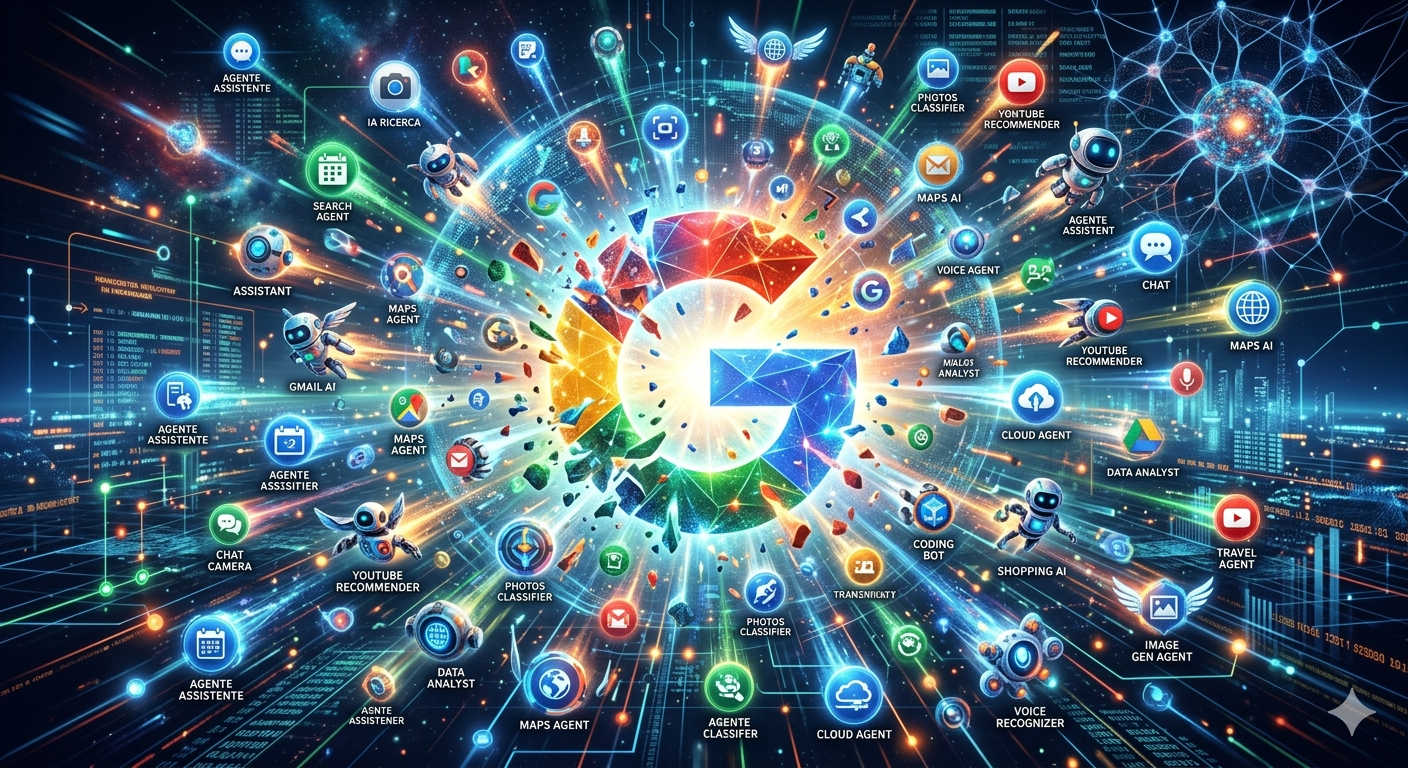
Google Search Is Over: How AI Agents Are Replacing the Way We Find Information
At Google I/O 2026, the company unveiled the most radical transformation of its search engine in over 25 years—turning the world's primary gateway to the internet into an AI-powered agent ecosystem that does everything from planning your vacation to building Android apps on your behalf.
Introduction
Google Search as you know it is over. The blue links—those familiar little clusters of text you've clicked on for decades—are no longer the primary way Google serves information. Instead, the search giant is rolling out a sweeping transformation that turns its search engine into a system of autonomous AI agents, capable of planning, browsing, synthesizing, and even acting on your behalf.
This isn't a minor product update. Google's own leadership has called it the biggest change to this entry point to the web since the search box was first introduced over 25 years ago. The shift touches not just search, but how billions of people access information, how publishers make money, how advertisers reach audiences, and ultimately what the internet itself looks like for the next generation of users.
For everyday people who check their email, plan a vacation, research a purchase, or look up a recipe every single day, this transformation will change the way we interact with the digital world in ways both convenient and profound.
What Happened: Google's Radical Transformation
At Google I/O 2026, held on May 19, 2026, Google unveiled one of the most ambitious product launches in its history. The centerpiece was a fundamental reimagining of Google Search—the product that has served as humanity's primary gateway to information since 1998. Over the course of the event, Google announced an ecosystem of nearly 20 AI-powered products, but the thread tying them all together was clear: Google is no longer a search engine. It is becoming an agent company.
At the heart of this transformation is Gemini Flash 3.5, a new AI model developed jointly with Google DeepMind. Unlike traditional chatbots that respond to your questions in a conversational format, Gemini Flash 3.5 is designed to act autonomously. It can plan multi-step tasks, execute them across multiple applications, and follow up on its own without constant human direction. A more powerful variant, Gemini 3.5 Pro, serves as the reasoning coordinator, delegating tasks to Flash as a high-speed executor.
The new system relies on several key innovations. Google's AI Overviews—which already serve over 2.5 billion monthly users—are being expanded into a fully conversational "AI Mode" now reaching more than 1 billion monthly users. The interface no longer presents lists of links. Instead, it generates dynamic, interactive layouts with real-time widgets, personalized mini-applications, and AI-powered summaries tailored to your exact query. Follow-up questions flow naturally within the same conversation, and the system proactively suggests related information.
Perhaps the most tangible example of Google's agent strategy is Gemini Spark, a continuous personal assistant that runs on Google Cloud's virtual machines, monitors your information needs around the clock, and autonomously executes long-term tasks. Through direct Gmail integration, users can email Spark at any time and it will scan email history for context, manage messages, draft responses, and coordinate across Google's entire suite of applications.
The scope of Google's announcements went far beyond search. The company also revealed Gemini Omni (a multimodal model turning images, audio, and text into video), Genie (a world simulation model fusing 20 years of Google Street View data into navigable 3D environments), voice-based prompting across Gmail, Docs, and Keep, a new Universal Cart for tracking shopping across the internet, audio-powered smart glasses, and an AI-powered app-building platform that lets anyone create Android applications in minutes using natural language. Every product reinforces the same message: Google is building toward a future where you don't search for information—information finds you.
"This is the biggest change to our entry point to the web since the search box was introduced more than 25 years ago." — Sundar Pichai, CEO of Google
The rollout is phased. The updated search interface began rolling out the week of May 19, 2026. Generative UI features and advanced information agents will debut in the summer, initially available to Google AI Pro and Ultra subscribers before broader deployment. Gemini Spark will launch next week exclusively for Google AI Ultra subscribers.
What This Means for You: Practical Examples
To understand the scale of this transformation, imagine yourself in three everyday situations where Google Search traditionally played a central role.
Imagine you're planning a family vacation. In the old world, you'd open Google, type "best family resorts in Mediterranean under $2000," click through three different travel sites, compare prices in five browser tabs, read reviews on two forums, and eventually book through a third-party site. In the new world, you simply tell Google: "We're a family of four looking for a Mediterranean resort in July, budget around $2,000, we like pools and kid-friendly activities." Google's AI agent reads your Gmail for past travel preferences, compares real-time prices across dozens of sites, generates a visual comparison table, and presents you with options you can book directly—all without you opening a single new tab.
Imagine you're a small business owner researching suppliers. You need to find a reliable manufacturer for a new product line. Previously, you'd type a query, scan through results, visit each website, fill out contact forms, and wait days for responses. Now you can describe your requirements conversationally: "I need a manufacturer in Vietnam for custom packaging, orders of 500 units, with food-safe certifications." Google's agent researches dozens of companies, verifies their credentials, compiles a ranked list with pricing estimates, and even drafts initial inquiry emails on your behalf.
Think about when you're researching a major purchase. You want to buy a new laptop and want honest recommendations. Previously, you'd read professional reviews on tech sites, watch YouTube videos, check Amazon customer reviews, and try to synthesize all that information yourself. With the new AI-driven approach, Google can summarize the consensus of thousands of professional and user reviews, highlight common strengths and weaknesses across sources, generate comparison tables, and even alert you to price drops across retailers—all presented in a format you asked for, not a format a website decided to show you.
Real-World Use Cases Across Sectors
Healthcare information access. A patient wants to understand a diagnosis or medication. Instead of searching symptoms on Google and potentially landing on alarming or misleading results, they can ask the AI agent in their own words. The system synthesizes information from reputable medical sources, organizes it into an understandable summary, and flags when professional consultation is recommended. This could reduce health anxiety caused by unfiltered search results while improving health literacy.
Education and learning. A student struggling with a complex topic can ask follow-up questions in their own language. The AI agent explains concepts at the student's reading level, generates practice problems customized to their knowledge gaps, creates visual aids from text descriptions, and even tracks their learning progress over time. Teachers can use similar tools to generate lesson materials at multiple difficulty levels, all tailored to their specific classroom needs.
Financial planning and investment research. An individual investor wants to understand how a new regulation might affect their portfolio. The AI agent monitors financial news across multiple sources, synthesizes expert analysis, cross-references historical data, and produces a personalized briefing that explains what changes mean for their specific holdings. This kind of sophisticated financial analysis was previously available only to professionals with access to expensive research platforms.
Everyday consumer assistance. You want to find the best deal on a product but don't have time to shop around. You describe what you need, your budget, and your priorities. The AI agent searches across retailers in real time, compares prices and shipping options, reads through customer reviews to surface quality concerns, and presents you with a short list of the best options—with the ability to complete the purchase without leaving the conversation.
Future Scenarios
Short-term (1–2 years)
Most Google Search users will interact conversationally rather than through typed queries. AI agents will begin booking flights, comparing insurance, and researching products with minimal human oversight. Publishers and media companies will face significant challenges as traditional search traffic continues to decline, forcing a reckoning in how quality journalism is funded.
Mid-term (3–5 years)
Search interfaces become nearly invisible—you stop thinking about "searching" because your AI agent handles most information needs behind the scenes. A new generation of AI-native search startups emerges, challenging Google's dominance with different approaches to agent-based information access. The internet's economic model shifts fundamentally, as advertising-supported content gives way to subscription and direct-payment models.
Long-term (10+ years)
Personal AI agents manage nearly all of your internet interactions—from filtering news to negotiating prices to coordinating with other agents. The line between "searching" and "doing" disappears entirely. The public web you know—open pages that anyone can find through a search query—may become less central as the internet shifts toward private, personalized, agent-mediated experiences.
Possible Evolutions of the Technology
The technology behind Google's agent ecosystem is likely to evolve along several key trajectories. First, multimodal integration will deepen—AI agents will combine text, voice, images, video, and real-world sensor data to provide responses that are contextually aware in ways that text-only models cannot match. Imagine asking your agent to evaluate a contractor's work by showing it photos, and having the agent cross-reference those images with building codes, local pricing data, and historical repair records.
Second, reasoning capabilities will continue to improve dramatically. Today's agents can plan and execute multi-step tasks, but future versions will handle increasingly complex problem-solving—from managing a household's energy usage in real time to coordinating supply chains for small businesses. Third, agent reliability and safety will become the central engineering challenge as these systems handle more consequential tasks. Google's recent improvements to safety safeguards—addressing concerns about potential harm from autonomous actions—represent just the beginning of what will be an ongoing effort.
Related developments to watch include the regulatory frameworks being developed for AI agents worldwide, the transformation of the digital advertising industry as search ads become obsolete, and new forms of content creation optimized for AI synthesis rather than human reading.
Implications: Benefits and Risks
Positive Implications
Democratization of expertise. For the first time, anyone with an internet connection can access information synthesis and analysis that previously required professional tools, subscriptions, or expertise. A student in a rural school can get personalized educational support. A small business owner can access market research capabilities once reserved for corporations with large budgets.
Time savings and productivity. The cumulative time saved by not having to click through multiple sites, cross-reference information, and manually compile data is enormous. Google's own executives have noted that the new system can complete in seconds what previously took users 20–30 minutes of searching and evaluating. For busy parents, entrepreneurs, and professionals, this translates to hours regained every week.
Accessibility for non-technical users. Natural language interfaces lower the barrier to technology use dramatically. Older adults, people with limited digital literacy, and those with disabilities can now interact with the internet's vast information resources through simple conversation rather than complex search techniques, filter settings, and interface navigation.
Negative Implications and Risks
Transparency and trust. When AI generates answers rather than pointing to sources, it becomes harder to evaluate where information came from and whether it can be trusted. Users may accept AI-generated content as fact without questioning its reliability. The phenomenon of AI "hallucination"—confidently presenting incorrect information as truth—becomes especially dangerous when applied to health, financial, or legal decisions.
Privacy concerns. For AI agents to function effectively, they require deep access to personal data: emails, search history, location, calendars, and communication patterns. This creates extraordinarily detailed profiles of individuals' behaviors, preferences, and relationships. Who controls this data? How long is it stored? Can it be accessed by governments or exploited by hackers?
Impact on journalism and content creation. Google's shift away from traditional search threatens the advertising-driven revenue model that has funded quality journalism, independent blogging, and countless forms of digital content for decades. When AI summarizes an article's key points directly in search results, readers have little incentive to visit the original site. Publishers are already struggling; this acceleration could devastate media outlets that rely on search traffic.
Concentration of power. When a handful of technology companies control the primary gateway through which billions of people access information, the risk of manipulation, bias, and censorship grows exponentially. Who decides which information AI agents prioritize? What happens when political or corporate interests pressure these companies to suppress or promote certain content?
Conclusion
Google's transformation of Search from a link-listing tool into an AI-powered agent ecosystem represents the most significant shift in how humanity accesses information since the dawn of the internet age. For billions of everyday users, this brings extraordinary convenience, accessibility, and productivity gains. But it also demands we become more critical consumers of information, more protective of our privacy, and more intentional supporters of quality journalism that sustains our information ecosystem.
The real question isn't whether AI can answer our questions—it increasingly can. The real question is whether we're prepared to live in a world where machines decide what information reaches us, in what form, and on whose terms. As we hand over the keys to our digital lives, we need to ensure that the future of information access serves humanity, not the other way around.
What do you think? Is AI-driven search a step forward or a step toward too much power for too few companies? Share your thoughts in the comments below.
Sources
- TechCrunch, "Google Search as you know it is over" (May 19, 2026) – https://techcrunch.com/2026/05/19/google-search-as-you-know-it-is-over/
- TechCrunch, "With Gemini 3.5 Flash, Google bets its next AI wave on agents, not chatbots" (May 19, 2026) – https://techcrunch.com/2026/05/19/with-gemini-3-5-flash-google-bets-its-next-ai-wave-on-agents-not-chatbots/
- TechCrunch, "Google introduces Gemini Spark, a 24/7 agentic assistant with Gmail integration" (May 19, 2026) – https://techcrunch.com/2026/05/19/google-introduces-gemini-spark-a-24-7-agentic-assistant-with-gmail-integration/
- TechCrunch, "OpenAI co-founder Andrej Karpathy joins Anthropic's pre-training team" (May 19, 2026) – https://techcrunch.com/2026/05/19/openai-co-founder-andrej-karpathy-joins-anthropics-pre-training-team/
- TechCrunch, "Google's Genie world model can now simulate real streets with Street View" (May 19, 2026) – https://techcrunch.com/2026/05/19/googles-genie-world-model-can-now-simulate-real-streets-with-street-view/
- TechCrunch, "Google updates its Gemini app to take on ChatGPT and Claude at IO 2026" (May 19, 2026) – https://techcrunch.com/2026/05/19/google-updates-its-gemini-app-to-take-on-chatgpt-and-claude-at-io-2026/