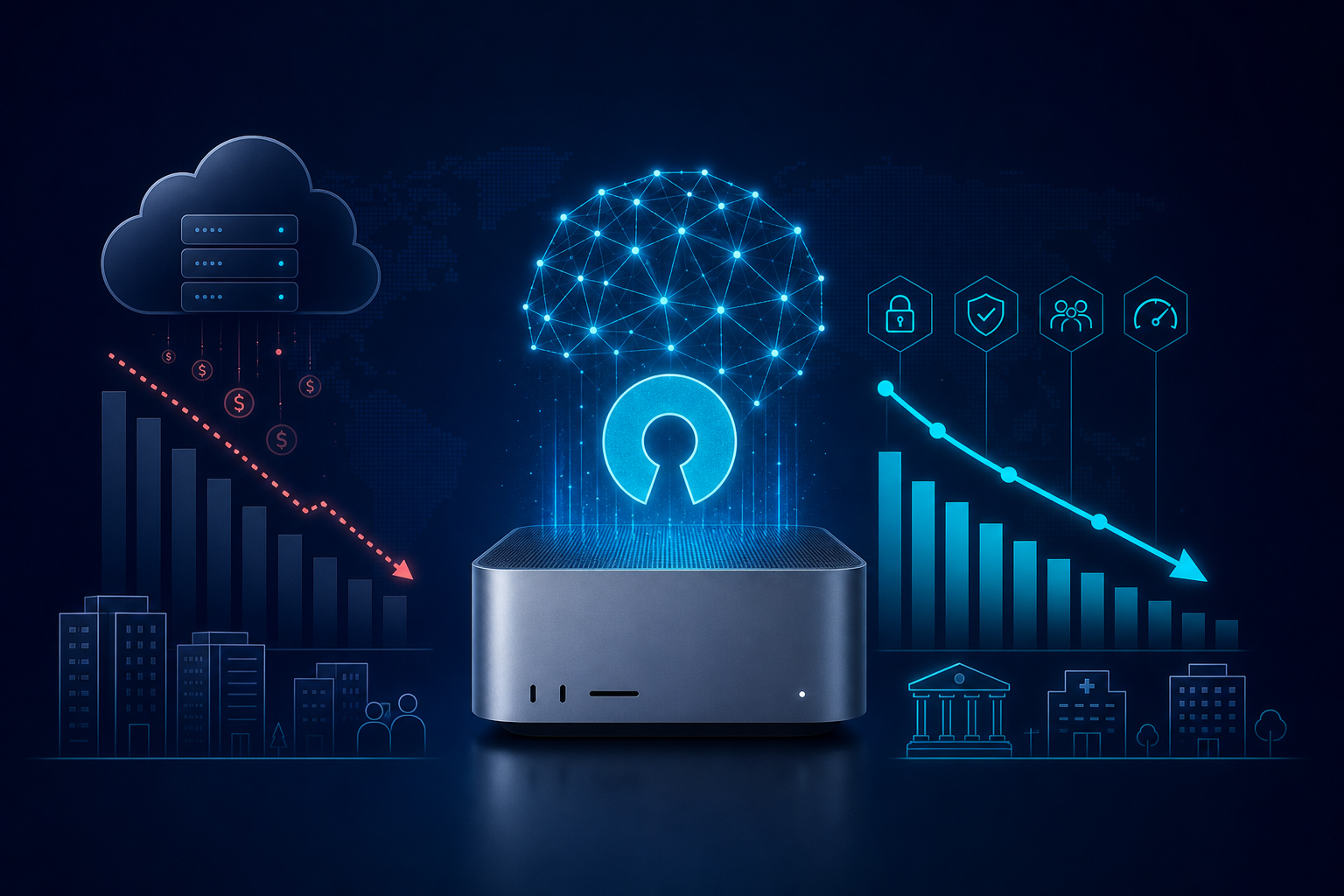
If you work in the technology sector or manage a company, you have likely noticed a troubling trend: the cost of artificial intelligence for businesses is growing at an exponential rate. This is no longer a marginal expense for chatbots and automations. Large organizations are burning millions of dollars annually on APIs, cloud infrastructure, and enterprise licenses. And the numbers tell a clear story.
According to the latest industry reports, companies spend an average of between $150,000 and $500,000 per year on large language model APIs alone. And this is only the beginning. Every additional request, every larger model, every performance improvement translates into steadily rising bills. When your dependency on AI becomes someone else's revenue, the game changes radically.
It is in this context that a new opportunity is emerging: building your own AI infrastructure. No longer an unreachable dream for startups, but a concrete and accessible reality even for small and medium-sized businesses. Let us explore how and why.
The Enterprise AI Cost Crisis
The paradox of enterprise AI is devastating in its implications. Cloud AI vendors promise scalable innovation and pay-per-use flexibility. In reality, the economic model works exactly like a lease you will never own: the more you use the service, the more you pay, and you will never become the owner of anything.
Consider a concrete example. A logistics company using AI to optimize routes, a manufacturing company deploying it for quality control, or a law firm using it for document analysis: all these scenarios share a common problem. Every query has a cost, every minute of inference is billed, every model improvement is a paid upgrade.
| Cloud API Scenario |
Estimated Monthly Cost |
Annual Cost |
| Enterprise chatbot with LLM API |
$5,000 - $15,000 |
$60,000 - $180,000 |
| Document analysis with embeddings |
$3,000 - $8,000 |
$36,000 - $96,000 |
| Computer vision for quality control |
$10,000 - $30,000 |
$120,000 - $360,000 |
| Custom AI agent (multi-model) |
$15,000 - $50,000 |
$180,000 - $600,000 |
These figures represent recurring cloud spend only. They do not include the total cost of ownership for on-premise infrastructure — and that distinction matters. Local AI is not "free after you buy a box." It is an investment with upfront capital, ongoing operations, and operational risk. But for workloads with sustained inference volume, the savings margin over cloud APIs can still be very large, even when you budget honestly for everything that keeps the system running.
The Open-Source Revolution Is Here
Five years ago, local AI was the domain of researchers and deep learning experts who spent nights fine-tuning models. Today, the situation is completely different. Open-source models have reached impressive quality levels, competing directly with commercial solutions on many tasks.
Models like Llama, Mistral, Qwen, and Gemma continue to emerge with ever-improving performance. The fundamental difference? These models can run locally, without per-token API billing, on your hardware, with your data.
🔑 The Crucial Point
When you use an open-source model on your own hardware, you gain three advantages that no cloud vendor can offer: total privacy (your data never leaves your infrastructure), complete control (you can fine-tune on your specific domain), and near-zero marginal inference cost (you pay for electricity and wear, not per request — though operations, maintenance, and redundancy are real and ongoing).
The open-source community does not just provide models: it also offers mature tooling. Ollama makes running LLMs locally as simple as a single command. LangChain and LlamaIndex provide frameworks for building complex AI applications. ComfyUI and AUTOMATIC1111 for image generation. LM Studio for interacting with models effortlessly. All free, all open-source, all functional.
Hardware Options: From Entry-Level to High-Performance
There is no single "right" machine for local AI. The choice depends on your workload volume, model size, latency requirements, and tolerance for operational complexity. What follows is a spectrum — not a prescription. The Mac Studio is mentioned here only as a well-known, accessible example, not as the recommended architecture for every organization.
Entry-level and proof-of-concept (roughly $2,000–$15,000)
For teams testing the waters, consumer GPU workstations or compact Apple Silicon machines can run smaller and quantized models effectively. A Mac Studio with 128 GB of unified memory (around $12,000 hardware only) illustrates what is possible at the approachable end: LLaMA-class models at 70B quantized, embedding pipelines, and moderate concurrent users. Similarly, a single RTX 4090 workstation (under $5,000 fully built) handles models up to roughly 13B parameters with 4-bit quantization. A Mac Mini with 32 GB (the current maximum configuration) suits lighter internal tools and development environments.
These setups are excellent for pilots and departmental use. They are not typically sufficient for company-wide, high-availability production — but they prove the model works before you scale up.
Mid-range production (roughly $15,000–$50,000)
When inference volume grows, dual-GPU workstations or small rack servers become the sensible step. Configurations with two RTX 4090/5090 cards, or a refurbished A100 40 GB or L40S server, deliver substantially higher throughput and support larger models (30B–70B range) with better concurrency. Expect hardware in the $20,000–$45,000 range before racks, networking, and redundancy — still a fraction of what equivalent sustained cloud API spend costs over two to three years for a busy deployment.
High-performance enterprise (roughly $50,000–$200,000+)
Organizations running heavy document pipelines, multi-agent systems, computer vision at scale, or strict latency SLAs will look beyond desk-side machines entirely. Multi-GPU servers with H100, A100 80 GB, or newer inference accelerators; dedicated inference clusters with load balancing; and redundant nodes for failover — these solutions cost more upfront, often $80,000 to $200,000 or beyond for a serious production footprint. They are also where the largest savings versus cloud appear: a deployment burning $30,000/month in API fees pays back a $150,000 on-premise stack in well under five years, while delivering lower latency, no egress fees, and full data sovereignty.
The point is not to minimize cost — it is to replace unpredictable, perpetual API billing with a capital investment you control. A $150,000 inference cluster sounds expensive until you compare it to $360,000 per year for a single computer-vision API line item in the table above.
“Local AI is not about buying the cheapest box. It is about matching hardware to your workload, budgeting for operations honestly, and escaping a billing model that never stops growing.”
The Real Cost of Ownership: Beyond the Sticker Price
Honest analysis requires more than comparing a Mac Studio price tag to an API invoice. Total Cost of Ownership (TCO) for on-premise AI includes recurring operational expenses that vendors and cheerleaders often omit:
- Power and cooling — GPU servers draw significant electricity; 24/7 inference nodes may add $200–$2,000+ per month depending on hardware and local energy rates. Cooling and rack space in non-datacenter environments matter too.
- Maintenance and support contracts — hardware warranties, extended support, and periodic component replacement (fans, drives, PSUs) over a 3–5 year lifecycle.
- Failures and downtime — disks fail, GPUs develop errors, power supplies die. Budget for spare parts, RMA cycles, and the business cost of outages unless you build redundancy.
- Backups and disaster recovery — model weights, fine-tuned checkpoints, vector databases, and configuration state all need backup strategy, off-site copies, and tested restore procedures. This is not optional for production systems.
- Monitoring, patching, and security — someone must apply OS patches, rotate credentials, monitor GPU health, and respond to alerts. Whether internal IT or a managed service, this is real labor cost.
- Networking and redundancy — redundant power (UPS), redundant network paths, and optionally a warm standby node for critical workloads add capital and operational cost — but far less than the revenue lost during an unplanned outage.
- Depreciation and refresh — inference hardware has a useful life; plan for partial or full refresh every 3–5 years as models grow larger and workloads expand.
- Staff time — even with mature tooling (Ollama, vLLM, llama.cpp), production deployments need someone who understands the stack. That may be a fractional role at smaller scale or a dedicated platform engineer at larger scale.
A realistic rule of thumb: add 15–30% of initial hardware cost per year for operations at small scale, and 10–20% at larger scale where efficiencies kick in — plus staff time on top. Even with that buffer, organizations with sustained inference load routinely find 40–70% lower five-year cost versus equivalent cloud API usage. The break-even point varies (often 18–36 months for mid-volume deployments), but the margin remains meaningful precisely because cloud costs scale linearly with usage while owned infrastructure does not.
⚖️ A Balanced View
Local AI is not a magic "buy once, pay never" formula. It is a financial and architectural bet: predictable capital and operations spend instead of open-ended API bills; operational responsibility instead of vendor convenience. For light or sporadic usage, cloud may still win. For steady, growing, or privacy-sensitive workloads, on-premise almost always deserves a serious TCO analysis — and that analysis should include maintenance, failures, backups, and people, not just the price on the invoice.
What We Could Do with Always-Available Local AI
Imagine this scenario. You have a local AI infrastructure running 24 hours a day, 7 days a week. No per-token API bills. No network latency to a remote datacenter. No vendor rate limits. Your data never leaves your building. What would you build?
Intelligent Customer Service
An AI assistant trained on your ticket history, your products, and your company policies. It responds in real time, in any language, with the same competence as your best operator. But it never sleeps, never gets sick, never quits. The marginal cost per conversation is electricity and infrastructure — not a line item on an API invoice.
Document Analysis in Milliseconds
Contracts, invoices, technical reports: your system analyzes them automatically, extracts key information, generates summaries, identifies risks. All local, all instant. No more files sent to third-party cloud services.
Personalized Employee Training
An AI tutor that adapts to each employee's level, creates custom learning paths, and answers role-specific questions. Trained with your internal materials, it knows your business better than any external trainer ever could.
Accelerated Research and Development
AI-assisted market research, competitor analysis, prototype generation with generative AI. Your R&D team gets an assistant that never sleeps, reads scientific papers in real time, and generates testable hypotheses.
The Real Competitive Advantage: Your Data
This is the point many overlook. A generic model, no matter how powerful, does not know your business. It knows millions of companies, but not yours. It does not know your procedures, your culture, your specific challenges.
When you build your AI infrastructure and fine-tune models with your company data, something remarkable happens: AI becomes intelligent in your specific domain. It is no longer a generic chatbot. It is an expert of your sector, trained on your knowledge, speaking your language.
And here lies the beauty of open-source: you can take an excellent base model, load your data on top of it, and get a model that is exactly what you need. No per-seat licensing from a vendor. No external party deciding when or whether to upgrade your plan. You control the roadmap — and you own the operational responsibility that comes with it.
Future Scenarios: Where Are We Heading?
Short-term (1-2 years): local AI infrastructure will become commonplace for SMEs running sustained workloads. Hardware costs will continue to fall, models will continue to improve. Medium-sized companies will deploy anything from compact proof-of-concept nodes to small GPU racks — choosing capacity based on TCO, not marketing hype.
Mid-term (3-5 years): we will see the rise of "AI-first companies" that rely primarily on owned inference capacity rather than perpetual API spend. Their advantage will not be in the base technology (which will be a commodity), but in their unique proprietary data, their operational maturity, and their ability to apply AI to their specific domain.
Long-term (10+ years): AI will become like electricity. You do not buy it "per kilowatt-hour" from a specific vendor. You produce it yourself, manage it yourself, and derive value from it. Companies that built their AI infrastructure from day one will be the ones that dominate their sectors.
Why Now Is the Right Time
Three factors are converging simultaneously, something never seen before in the history of computing:
- Open-source models are finally competitive — they are no longer "the community's models." LLaMA, Mistral, Qwen, Gemma: all reach or surpass commercial models on many benchmarks.
- Hardware spans a wide range — from sub-$5,000 workstations to six-figure inference clusters, there is a tier for every stage of adoption. Entry-level machines prove the concept; high-performance stacks deliver the throughput that makes cloud alternatives economically indefensible at scale.
- Software is mature — tooling like Ollama, vLLM, llama.cpp, and Text Generation Inference makes local deployment as simple as installing an app. You no longer need a team of ML engineers.
This convergence will not last forever. Sooner or later, major vendors will close the gap between their closed models and open-source. Or specialized hardware will become more expensive. Or open-source software will become complex to manage. But now? Now the timing is perfect.
Conclusion
The cost of enterprise AI is no longer sustainable as a perpetual cloud-only model for organizations with growing inference demand. Companies that never run the numbers will continue paying rising API tariffs for capacity they do not control. But there is a concrete alternative: building your own AI infrastructure with open-source models, hardware matched to your workload, and mature deployment tooling — budgeted honestly, including maintenance, failures, backups, and staff.
The Mac Studio is a useful illustration of what entry-level local AI looks like. A dual-A100 rack is a useful illustration of what serious production looks like. Neither story is complete without the operational costs that keep systems alive. Even with those costs included, the long-term savings margin over cloud APIs can be substantial — and the strategic benefits of privacy, control, and predictable spend are difficult to price on a vendor invoice alone.
The question is no longer "Can we afford the hardware?" but "Can we afford to keep renting intelligence from someone else's datacenter forever?"
Sources & References
- McKinsey & Company — The State of AI in 2025
- Stanford HAI — AI Index Report 2025
- Anthropic Research — Scaling Laws for Agentic AI
- Ollama Documentation — ollama.com
- Mistral AI — mistral.ai
- Apple — Mac Studio Specifications