Physical AI and the Neural Channel
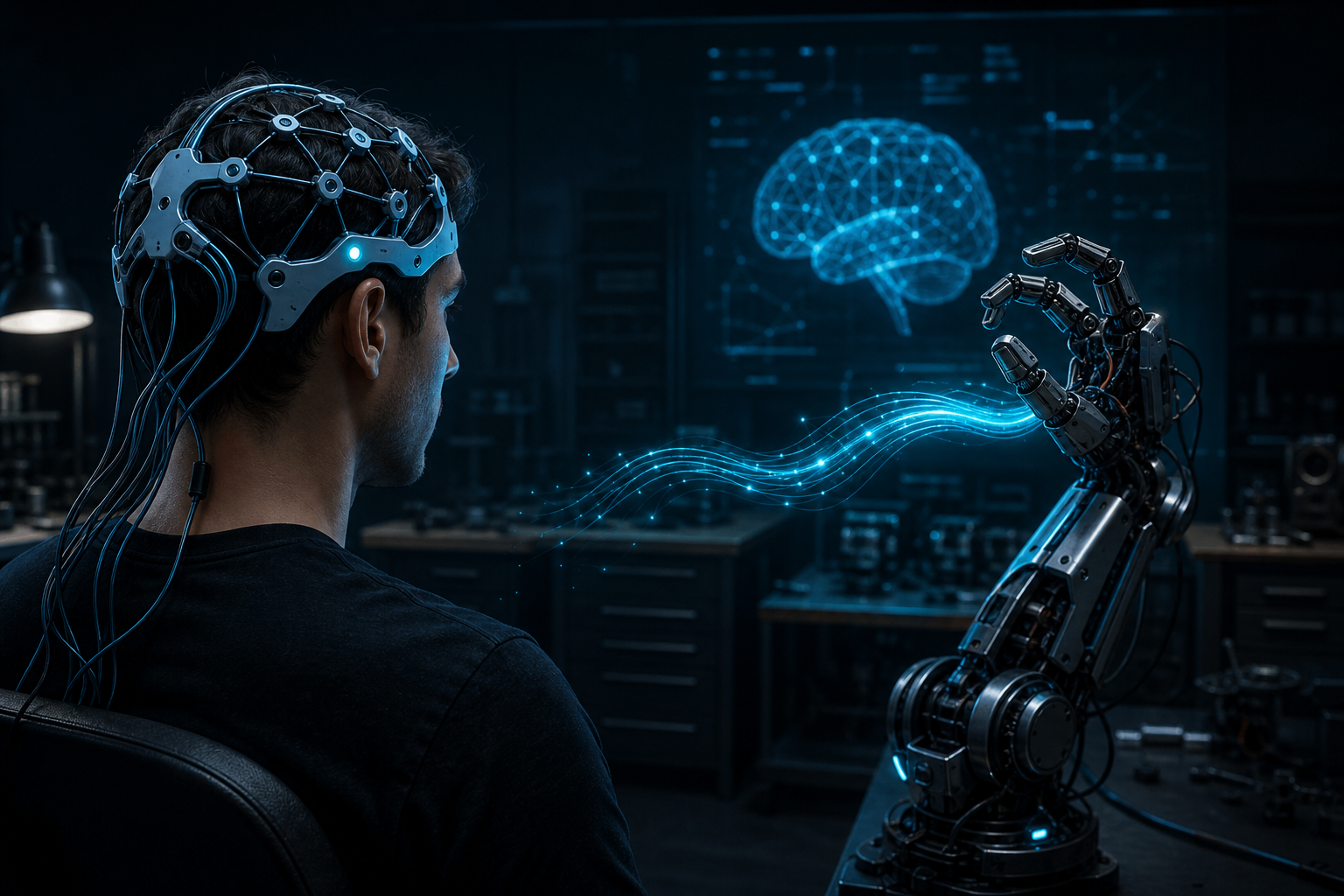
Physical AI — robots, drones, exoskeletons, autonomous manipulators — needs intent. Today that intent arrives via joystick, touchscreen, or voice commands processed in the cloud. Brain-computer interfaces (BCI, Brain-Computer Interface) offer a different channel: neural signals translated into control commands, bypassing muscles and sometimes even speech.
The field spans decades of clinical research and a recent wave of consumer hardware. Progress is real but uneven. Invasive implants can decode fine motor intent for paralyzed patients; consumer EEG devices mostly detect coarse mental states like concentration or relaxation. Connecting both classes of BCI to a robotic stack remains a maker project, not a plug-and-play product — and that is exactly the kind of problem robotics builders should understand.
This article explores how BCIs interface with physical robotics, what is realistic today in a maker garage, and what remains in the clinical domain. We are not promising industrial telepathy: we are promising honest engineering.
Why Now?
OpenBCI has matured documented SDKs, ROS 2 simplifies integration with arms and mobile bases, and Neuralink has brought invasive BCIs into public debate. In 2026, the cost of an experimental EEG setup has dropped below €500 — the window for accessible prototypes is open, ethical responsibilities included.
Types of BCI: Invasive and Non-Invasive
Invasive BCIs
Electrodes placed on or inside the cortex record neural activity at high fidelity. Systems like the Neuralink implant, Utah arrays used in academic labs, and ECoG (electrocorticography) grids fall into this category. Signal quality is excellent; surgery, infection risk, and long-term biocompatibility are the costs.
Work published by research hospitals has demonstrated cursor control, reach-and-grasp with a robotic arm, and typed digital communication at modest bit rates — typically tens of bits per minute for untrained users, higher with intensive calibration. These are hard-won clinical milestones, not consumer gadgets.
Non-invasive BCIs
EEG caps and headbands measure electrical activity on the scalp through the skull. The signal-to-noise ratio is lower and spatial resolution is coarse, but setup takes minutes instead of months of recovery. Devices like Muse, Emotiv, and OpenBCI Cyton boards dominate the maker and wellness segments.
Non-invasive BCIs reliably detect event-related potentials, power variations in alpha/beta bands, and simple binary states ("concentration" vs "relaxation"). Fine finger-level decoding from EEG alone remains an open problem for most users.
| Characteristic | Invasive (implant/ECoG) | Non-invasive (scalp EEG) |
|---|---|---|
| Spatial resolution | Millimeter-scale (cortex) | Centimeter-scale (blurred by skull) |
| Setup | Surgery, clinical trials | Minutes; electrode gel optional |
| Typical cost | Millions in R&D; not purchasable | €200–2000 (OpenBCI, Emotiv) |
| Fine robot control | Advanced clinical research | Coarse commands, mental switches |
| Biological risk | Infection, rejection, ethics | Negligible (topical) |
The gap between "I know you are concentrating" and "move the gripper 12 mm on the Y axis" is where most BCI-robotics projects live — in intelligent middleware, not magical mind reading.
Neuralink and the Surgical Track
Neuralink has reported progress with fully integrated wireless implantable devices in small participant cohorts, initially focusing on assistive communication and cursor control. Public updates emphasize increasing channel count and reducing per-channel noise. Regulatory pathways differ by country; what is permitted in a trial does not equal a consumer neuro-gaming peripheral cleared for sale.
For Physical AI, the surgical track matters because high-bandwidth intent signals could one day guide multi-DOF prosthetics or telepresence robots with less cognitive load than switch-scanning interfaces. That future is plausible; it is not available as a standard robot API in 2026.
What to expect (and what not to)
- Realistic: cursors, menu selection, discrete commands for users with severe motor disability under medical protocol.
- In development: continuous prosthetic control with closed-loop sensory feedback.
- Not realistic today: piloting a humanoid factory robot "by thought" without supervision.
Why Now?
Public debate around Neuralink has sensitized investors and regulators to invasive BCIs. Even if you do not build implants, understanding that track helps you position correctly what OpenBCI can do in the garage — complementary, not competitive.
Consumer EEG: Muse, Emotiv, and Beyond
Consumer EEG has matured in the wellness segment: guided meditation, focus metrics for productivity, sleep. Muse S and similar headbands use a few dry electrodes, comfortable but scientifically limited for precise robotic control.
Emotiv offers more research-oriented SDKs with pre-trained classifiers for facial expressions and affective states. OpenBCI remains the maker's preferred choice for open firmware, expandable channels, and LSL (Lab Streaming Layer) integration.
Consumer EEG limits for robotics
- Motion artifacts: blinking or turning your head corrupts the signal.
- Low SNR through the skull: decoding "imagine right-hand movement" requires hundreds of trials per user.
- Classification latency: 200–500 ms typical for P300 or SSVEP systems — acceptable for switches, not for tight real-time control.
For demos and hackathons, consumer EEG is enough. For clinical assistance or industrial safety, rigorous protocols and research-grade hardware are required.
Robotic Control Pipeline
A practical BCI-robot pipeline has four layers:
- Sensing: EEG, EMG, or implant streams sampled at hundreds/thousands of Hz.
- Decoding: machine learning maps signal patterns to discrete commands or continuous velocity vectors.
- Intent fusion: a safety supervisor merges BCI output with obstacle maps, joint limits, and estop logic — never raw neural signals directly to motor drivers.
- Actuation: ROS 2 nodes, microcontrollers, or PLC interfaces move the physical plant.
Coarse control schemes work today: blink to confirm, imagine hand squeeze to close gripper, focus to start and relaxation to stop. Continuous teleoperation — steering a mobile base with imagined movement — appears in research demos with extensive per-user training.
Physical AI and goal selection
Physical AI adds a twist: embodied models that predict contact forces and object affordances. A BCI could select goals ("pick up the red cube") while a local policy handles grasp geometry — similarly to how voice assistants trigger skills they do not directly execute.
| Pipeline level | Typical technology | Target latency |
|---|---|---|
| Acquisition | OpenBCI + LSL, 250–500 Hz | < 5 ms USB jitter |
| Classifier | scikit-learn, lightweight PyTorch | 10–50 ms |
| Safety supervisor | ROS 2 lifecycle, watchdog | < 10 ms |
| Actuator | velocity_controller, MoveIt 2 | Depends on robot |
Maker Guide: OpenBCI + ROS 2
You do not need cranial surgery to experiment. The OpenBCI hardware ecosystem provides open-source EEG/EMG acquisition with documented SDKs. A typical weekend project:
- Stream OpenBCI data via LSL into a Python decoder.
- Train a simple classifier on two mental states or muscle contractions.
- Publish ROS 2
geometry_msgs/Twistor custom service calls to a mobile robot or arm. - Wire a hardware estop that the BCI cannot disable.
Example: ROS 2 publisher from EEG classifier
# bci_twist_publisher.py (simplified)
import rclpy
from rclpy.node import Node
from geometry_msgs.msg import Twist
from pylsl import StreamInlet, resolve_streams

class BciTeleop(Node):
    def __init__(self):
        super().__init__('bci_teleop')
        self.pub = self.create_publisher(Twist, '/cmd_vel', 10)
        streams = resolve_streams('type', 'EEG')
        self.inlet = StreamInlet(streams[0])

    def tick(self):
        sample, _ = self.inlet.pull_sample(timeout=0.1)
        label = self.classify(sample)  # 0=stop, 1=forward
        msg = Twist()
        if label == 1:
            msg.linear.x = 0.1  # limited m/s
        self.pub.publish(msg)

# Start with: ros2 run your_pkg bci_teleop
# Robot: ros2 topic echo /cmd_vel
Per-user calibration
Every brain is different. Collect 50–100 epochs per class (focus vs relax, squeeze vs rest) before deployment. Repeat calibration if you change electrode position or if the user is tired. Do not expect cross-subject generalization without transfer learning.
Why Now?
ROS 2 Humble/Jazzy, OpenBCI GUI with LSL export, and community tutorials on GitHub lower the barrier to entry. A BCI-robot undergraduate thesis project is feasible in one semester with €400 hardware.
EMG: A Pragmatic Alternative
Surface electromyography reads muscle activation on the skin. For many robot makers, EMG armbands provide more reliable discrete commands than EEG — closed fist, wrist flexion, rest. Myo-style armbands are commercially discontinued, but DIY EMG with OpenBCI Ganglion or dedicated EMG boards remains practical.
Treat EMG as part of the "biological input" family when BCIs are too noisy. A 4-channel EMG classifier can command gripper open/close with >95% accuracy after 10 minutes of training — numbers impossible with consumer EEG on the same user.
# Simple EMG threshold example (pseudocode)
emg_rms = compute_rms(channel_forearm)
if emg_rms > THRESHOLD_HIGH:
    send_gripper_command('close')
elif emg_rms < THRESHOLD_LOW:
    send_gripper_command('open')
Safety first: Never connect experimental BCI decoders directly to high-power industrial actuators. Use velocity limits, sandbox environments, and physical estops. A misclassified "focus" signal must not crush a hand.
Ethics, Privacy, and Regulation
Neural data is among the most sensitive biometric information. Even non-invasive EEG can reveal affective states, fatigue, and attention patterns. Treat it as PHI (Protected Health Information) when human participants are involved.
Operational principles
- Informed consent: document what you record, for how long, and who accesses the data.
- Minimization: do not archive raw EEG beyond what the project requires.
- Medical devices: implants and clinical trials require institutional ethics approval — do not improvise.
- Cybersecurity: wireless BCI streams are an attack surface; isolate lab VLANs.
- Equity: BCIs must not replace existing accessible interfaces without user choice.
Reading the brain is not like reading a log file: it is an act with implications for autonomy, dignity, and legal responsibility that no ROS middleware resolves on its own.
Future Outlook
Short term (1–3 years)
Consumer EEG improves wellness and simple accessibility switches. Research implants expand assistive cases under trial protocols. Maker integrations with ROS remain niche demos at conferences and hackathons.
Medium term (3–7 years)
High-channel-count wireless implants could pair with on-device decoders for prosthetics and telepresence. Regulatory frameworks clarify liability when neural intent guides semi-autonomous machines. EMG+vision fusion becomes common in exoskeletons before pure BCI.
Long term
Thought-action at scale requires stability, cybersecurity (sensitive neural data), and social acceptance. Physical AI stacks will treat BCIs as one input modality among many — not a replacement for proven joysticks and voice in production environments.
Conclusions
Brain-computer interfaces and Physical AI converge on the question of intent: how a human tells a machine what to do in the physical world. Invasive systems lead on fidelity; non-invasive EEG leads on accessibility; EMG often wins in maker garages for reliability.
Build small, publish your decoders, respect clinical boundaries, and always separate experimental neural input from safety-critical actuation. The sci-fi version — silent telepathic control of humanoid robots — is not here. The engineering version — assistive, hackable, incrementally useful bridges between brains and machines — absolutely is.
Sources
- OpenBCI — Open-source biosensing hardware and documentation
- ROS 2 — Robot Operating System documentation
- Neuralink — Public updates on implantable BCIs (clinical trial context)
- Muse / InteraXon — Consumer EEG for meditation and focus applications
- Academic BCI literature — Utah array and ECoG motor decoding reviews (PubMed, IEEE TBME)