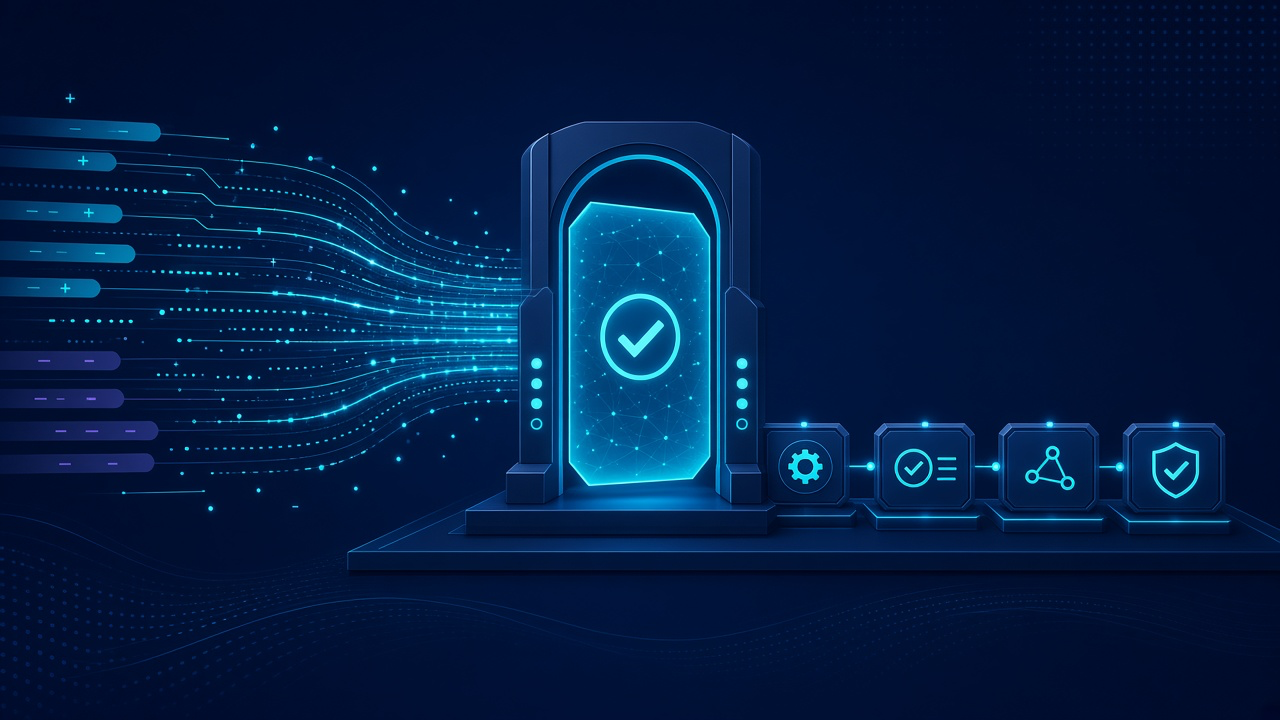
For more than twenty years, one rule has governed how software ships: no code goes live without a second set of eyes. That rule is called code review, and it is one of the most ordinary, invisible parts of modern technology. Every app on your phone, every banking transaction, every airline booking system, every medical record on file — all of it passed through the hands of a human reviewer who checked the work before it was trusted. Review was the last gate, the final checkpoint between "someone wrote this" and "this is safe to run." It was a ritual we never questioned, because it seemed obvious that a machine could write code but only a person could judge it.
That assumption just changed. In mid-November 2026, Anthropic — the AI company behind the model Claude — launched a product called Claude Ship, an agent that does not merely assist with code review. It performs the entire final stage of the software development pipeline on its own: it reads the changes, fixes the problems it finds, and approves the code — all without waiting for a human to press a button. Within days, it was covered by TechCrunch, SiliconANGLE, and Help Net Security as one of the first fully autonomous sign-offs in a development workflow. The software industry has been talking about AI writing code for years. Nobody had, until now, let the AI be the one to say "yes, this is good enough to ship." That is a line that, once crossed, cannot be uncrossed.
This article explains what Claude Ship actually is, why it matters far beyond software developers, and what it means for the way we think about trust, responsibility, and who is really responsible when an automated system makes a mistake. No background in programming is required — only a willingness to think carefully about a change that will touch almost every part of the digital economy.
Why this matters: Code review is the last human checkpoint before software goes live. When an AI can now review, fix, and approve code on its own, we are no longer talking about a tool that helps developers work faster. We are talking about the first time the final gate of software development has been handed to a machine.
What Happened: The Launch of Claude Ship
To understand why Claude Ship is significant, it helps to understand what it replaced. In a typical team that builds software — whether it is a startup of five people or a bank with thousands of engineers — work happens in stages. An engineer writes some code. That code is submitted as a "pull request," a change that proposes something new or different. Before it can be merged into the main body of the program, another person — usually a senior colleague — reviews it. They look for bugs, security holes, sloppy logic, or anything that might break when real users start relying on it. If the review is clean, they approve it. If not, they send it back with notes. This is not bureaucracy for its own sake. Software is so deeply woven into daily life that a single unchecked change can leak customer data, drain bank accounts, or take down a service used by millions.
For years, AI has been good at the first part of that job: writing code. Tools that suggest the next line, generate a function, or explain what a piece of code does have become common. But writing and reviewing are different skills. A writer can be confident and wrong; a reviewer must be skeptical and precise. Most AI coding tools were deliberately kept on the writing side of that line, with humans firmly in charge of the approval. Anthropic's Claude Ship is different because it crosses that line. Instead of only helping an engineer draft code, it takes over the review itself — reading the changes, identifying problems, patching them, and granting final approval, all autonomously.
The implications are immediate. For teams drowning in pull requests — a problem that slows down even the most efficient companies — Claude Ship promises to collapse a multi-day backlog into hours. It can read a change, understand its intent, and decide whether it is safe, flagging only the genuinely ambiguous cases for a human. For smaller teams and solo developers who cannot always afford a senior reviewer, it offers a kind of expert-level oversight that was previously out of reach. And for enterprises, it represents the first real step toward what some call the "software factory": a pipeline where most of the repetitive, well-defined work is done by machines, and humans intervene only where judgment truly matters.
But the technology also raises questions that have no easy answers. Who is responsible when an AI approves code that later causes harm — the developer who wrote it, the company that bought the tool, or the AI itself? Can a machine understand the context of a decision well enough to vouch for it? And how do we keep a human in the loop when the whole point of the tool is to remove the human from the loop? These are not theoretical questions. They are being answered right now, in real companies, as Claude Ship and similar tools move from laboratories into production systems.
Practical Examples: What This Looks Like in Real Life
It is easiest to understand Claude Ship by imagining a few everyday situations where software quietly decides things for us. The point is not to imagine science fiction, but to recognize that the software behind ordinary services is built by millions of small changes — each of which used to require a human sign-off.
Imagine you are a small business owner running an online store. Every week, someone updates the checkout page, tweaks the shipping calculator, or adds a new payment option. Each of those changes used to pass through a reviewer who could catch a mistake — like a shipping fee that accidentally charges customers in another country, or a discount that applies twice. With an autonomous reviewer, those updates could be checked and approved instantly, at any hour, without waiting for a colleague to finish their coffee. The upside is speed and reliability. The risk is that a subtle bug — one that only shows up under unusual conditions — might slip through something no human caught.
Now imagine you are a hospital administrator. Software in a hospital manages appointment schedules, drug interactions, and patient records. A single error in that software can have serious consequences. If an AI reviews and approves changes to that system, it must understand not just whether the code is "correct," but whether it is safe in a context where mistakes cost more than money. This is exactly why healthcare, finance, and transportation are the areas where autonomous approval will be both most valuable and most closely watched.
Finally, imagine you are a developer who has spent the last ten years doing code review — the careful, meticulous work of checking other people's code. This job, once considered secure and senior, is now being reshaped. That does not necessarily mean the job disappears. It may mean it changes: reviewers become editors of AI decisions, auditors of automated systems, and guardians of the judgment calls a machine cannot make. But the shift will be real, and the people who live through it will be the first generation to watch a core professional skill become partially automated.
Use Cases Across Industries
The impact of autonomous code review will not be felt equally everywhere. Some fields will adopt it quickly because the payoff is large and the stakes are manageable; others will move slowly because the cost of a mistake is high. Here are several areas where the technology is likely to matter most.
Financial services. Banks and insurance companies run on software that processes trillions of dollars and must comply with strict regulations. Automated review can check thousands of changes against compliance rules at once, catching violations a human might miss. But because financial errors can trigger market instability, this field will also demand the strongest human oversight.
Healthcare and medical devices. Software in hospitals, diagnostic tools, and wearable devices must be extraordinarily reliable. Autonomous review could speed up updates while flagging anything that might affect patient safety — but every approval in this space will likely require a human sign-off for the foreseeable future.
Consumer apps and e-commerce. This is where the payoff is largest and the risk is smallest. The millions of small updates that keep shopping sites, food-delivery apps, and social networks running smoothly are exactly the kind of repetitive, well-defined work that autonomous review handles best. Most of these will be approved without human intervention.
Open-source software. Much of the internet is built by volunteers who maintain code in their free time. For these projects, an autonomous reviewer could provide expert-level checking that communities have never been able to afford, potentially improving the safety of the very tools billions of people rely on.
Autonomous systems. Cars, drones, and robots all run on code that must be flawless. This is the frontier where autonomous review will be both most promising and most controversial — because the cost of failure is measured in physical harm, not just dollars.
Future Scenarios: What Comes Next
Short term (1–2 years): We will see autonomous review become common in "low-risk" environments — internal tools, prototypes, and consumer apps where mistakes are cheap to fix. Teams will begin to treat it like a new kind of assistant, one that handles the tedious part of review so humans can focus on the important part.
Mid term (3–5 years): As the technology matures, we will see the rise of "reviewer teams" — a mix of AI agents and human supervisors, where the AI does the heavy lifting and humans handle the judgment calls. New roles will emerge, such as "AI oversight engineer" or "automated-system auditor." The definition of what it means to "review code" will change fundamentally.
Long term (10+ years): If the trend continues, we may reach a point where the vast majority of software is written, reviewed, and approved by autonomous systems, with humans setting goals and values rather than checking individual lines of code. At that point, the most important skill may not be writing code, but knowing what questions to ask the machines that write it — and being able to tell when something has gone wrong in a way the machine cannot detect.
How the Technology Evolved to Reach This Point
Claude Ship did not appear overnight. It is the latest step in a long chain of developments that began with simple code-completion tools and moved, steadily, toward autonomy. The first generation of AI coding assistants could suggest the next word in a line of code — a bit like spell-check for programmers. The next generation learned to write entire functions and explain what they did. Then came the "agents": programs that could carry out multi-step tasks, like fixing a bug across several files or setting up an entire project.
The leap to autonomous review is different because it requires something more than skill. It requires judgment — the ability to weigh trade-offs, understand context, and decide when "good enough" is truly good enough. This is why it arrived later than code generation, and why it is more controversial. The same advances in AI that made writing faster also made reviewing possible, but reviewing demands a kind of caution and wisdom that machines are still learning to emulate.
The Implications: Promise and Peril
Like every transformative technology, Claude Ship brings both great opportunities and serious risks. Understanding both is essential to making good decisions about it.
The positives. First, speed: changes that once took days can be reviewed in hours, letting companies ship fixes and features faster than ever. Second, access: smaller teams and developing countries can get expert-level oversight that was previously available only to large, wealthy organizations. Third, consistency: unlike humans, an AI reviewer does not get tired, distracted, or rushed, and it applies the same standards to every single change. Fourth, focus: by handling the tedious work, it frees human developers to concentrate on creativity and complex problem-solving, where they add the most value.
The risks. First, responsibility: when an automated system makes a mistake, it is unclear who is to blame — the developer, the company, or the AI. Second, hidden errors: an AI might approve code that is technically correct but contextually dangerous, catching nothing that a human with domain expertise would have spotted. Third, over-reliance: if teams stop reviewing entirely, they may lose the ability to spot problems themselves, becoming dependent on systems they no longer understand. Fourth, security: if attackers learn to exploit the AI's judgment — feeding it changes that look fine but contain subtle vulnerabilities — they could find a new, powerful way to break into software.
Balanced view: The most likely future is not one where humans are replaced, but where the relationship between humans and machines is redefined. The tools that succeed will be the ones that keep a thoughtful human in charge of the decisions that matter, while offloading the repetitive work. The question is not "will AI replace reviewers?" but "how do we use AI to make review better, without losing the human wisdom that makes review meaningful in the first place?"
Conclusion
The launch of Claude Ship marks a quiet but profound turning point. For two decades, code review has been the last human checkpoint before software goes live. Now, for the first time, a machine can perform that checkpoint on its own. That is simultaneously exciting and unsettling — a reminder that the most important changes in technology are rarely the ones that are loudest.
The story of Claude Ship is not really about AI. It is about trust. Every time we let a machine approve something, we are deciding what we are willing to trust it with — and what we are not. The companies and societies that thrive in the years ahead will be the ones that figure out how to harness the power of automated judgment while keeping the human wisdom that machines still lack. The last gate of software development has opened. The real question is who we want to be standing on the other side of it.