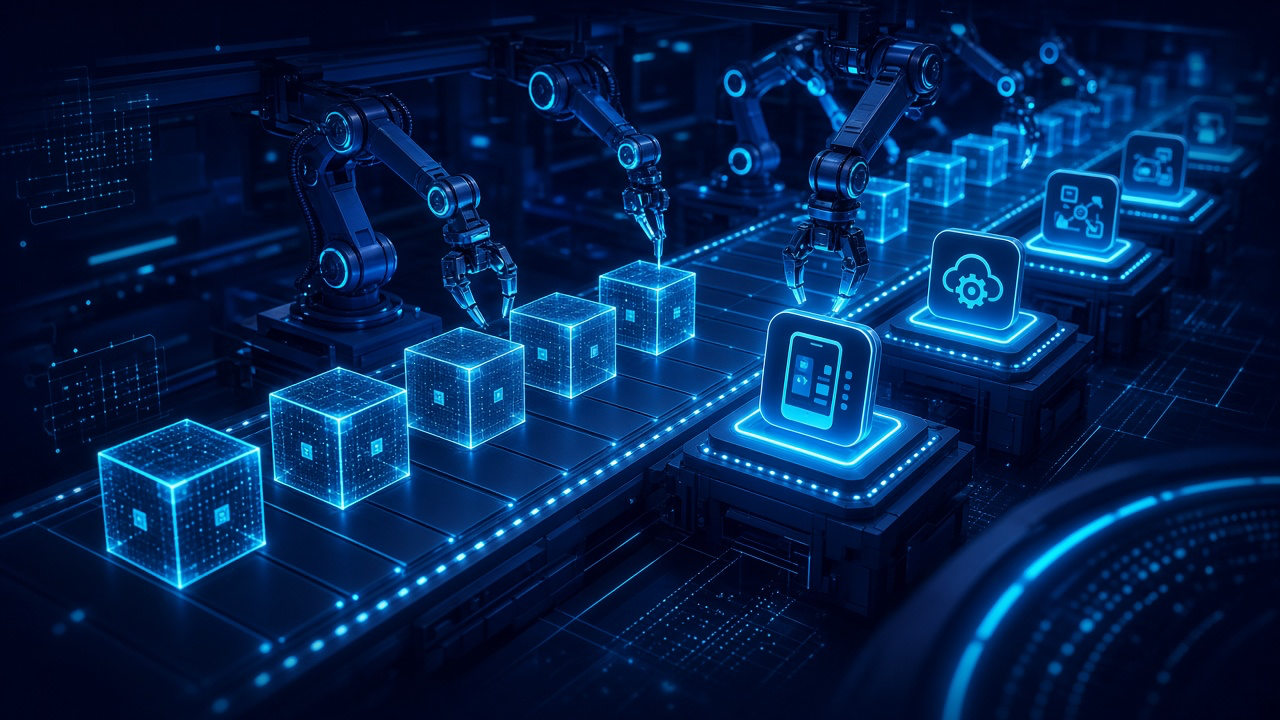
There is a word that has not been associated with creativity for a long time: factory. We think of factories as places of repetition, of assembly lines, of products rolled out in identical rows. We contrast them with the studio, the workshop, the place where unique things are made by hand. For decades, software has been thought of as the ultimate studio — a place where creative people solve novel problems, one elegant solution at a time. But something is changing. A growing number of the world's largest technology companies have started talking about their development work in a way that would have sounded strange just a few years ago: they call it a factory. They are applying the logic of the assembly line to the art of software, and artificial intelligence is the machine that makes it possible. This is not just a story about faster coding. It is a story about how we think about creativity itself, and what happens when we try to mass-produce the thing that was supposed to be uniquely human.
To understand what is happening, it helps to trace how we got here. The way software is built has changed dramatically over the decades, and each change made it more like manufacturing — more standardized, more systematic, more efficient. But this year's shift is different in kind, not just in degree. For the first time, the actual writing of code — the core creative act — can be done mostly by a machine. The question that follows is unavoidable: if the writing is automated, what is left for the humans? And the answer, it turns out, is more interesting than either the optimists or the pessimists expect.
Why this matters: Almost every business, organization, and service now depends on software, yet building it has always been slow and expensive. If AI can turn software development into an efficient, automated process, it could change how much software the world gets to build — and who gets to build it. That has implications for every industry, every job, and every product we use.
What Happened: The Rise of the Software Factory
The term "software factory" is not new, but it has taken on a fresh meaning this year. In its original sense, it described the attempt to apply industrial methods to software — standardized components, repeatable processes, and careful quality control. The dream was to build software the way a car is built: from known parts, on a predictable schedule, with few surprises. That dream partially failed for decades, because software is so unlike a car. Every problem is different, every system is unique, and human creativity simply will not fit neatly into an assembly line.
This year, something has shifted. The arrival of sophisticated AI coding tools has made it possible to automate not just the parts of software development that were already repetitive — testing, documentation, routine fixes — but the core creative act itself. Companies that build software at enormous scale have begun to structure their entire operation around this new reality. One of the largest ride-sharing companies described running its software development "efficiently at Uber scale," meaning it had built a system capable of processing a massive volume of software changes continuously. Another internet infrastructure company reported driving its backlog of software tasks down to essentially zero — a metaphorical way of saying its pipeline had become so efficient that nothing was ever left waiting. These are not small achievements. They represent a fundamental reorganization of how software gets made.
The factory metaphor is powerful precisely because it captures what is both exciting and unsettling about this shift. A factory is efficient, consistent, and powerful. But it is also, by design, impersonal. It optimizes for output, not for the joy of creation. The people who work in factories are often managers of machines rather than makers of products. As software companies adopt this model, we are forced to ask what becomes of the developer when the machine does most of the work — and whether there is something lost when creativity is industrialized.
Practical Examples: What a Software Factory Looks Like
The concept feels abstract until you see it in action. Let me paint a few pictures that should make it tangible.
Imagine a large online store that changes its website dozens of times a day — new products, seasonal sales, corrected prices, fixed bugs. Five years ago, each of these changes required a developer, who would write code, wait for review, and slowly deploy it. The team could handle maybe a hundred changes a week. Today, with a factory-style system, the routine changes are handled automatically by AI. A developer simply describes what they want — "add a 20% discount on shoes for the weekend" — and the AI writes the code, tests it, and prepares it for release. The developer reviews a few changes a day instead of writing a hundred a week. The store can now respond to the market instantly, but the developer's job has changed from writer to editor.
Now imagine a company that used to dream of building features it could never afford. Perhaps a small tool that reminds customers about their upcoming renewals, or a dashboard that predicts which clients might leave. These ideas were too small to matter individually but too numerous and tedious to build by hand. In a factory model, these become cheap to build. The company no longer has to choose between its ambitions and its budget, because the cost of building each small feature has collapsed. The factory does not just work faster; it makes the impossible affordable.
Finally, imagine the person who used to do the tedious work. Consider a developer who spent their early career writing the same kinds of boilerplate — the boring, repetitive code that every program needs but nobody enjoys. This is exactly the work that a factory automates. That developer is not necessarily out of a job, but they are pushed toward work that is harder and more valuable: designing systems, understanding what people actually need, and making the judgment calls that a machine cannot. The factory changes what is worth doing, even if it does not always make the doing disappear.
Use Cases Across Industries
The factory model will not transform every field equally. Some will adopt it quickly; others will be cautious. Understanding the differences helps explain the bigger picture.
Large technology companies. These are the early adopters, because they have the scale that makes automation worthwhile. Their pipelines process millions of changes, so even small efficiency gains translate to enormous savings. They are also the laboratories where the factory model is being tested and refined.
Financial services. Banks and insurers run on vast, complex software that must be updated constantly to comply with changing rules. A factory approach could let them respond to regulations quickly and consistently, though the high stakes mean humans will remain firmly in charge of the most important decisions.
Healthcare. Hospitals and health systems need software that is both innovative and safe. The factory model could speed up the development of patient tools and administrative systems, but the life-critical nature of the work means every automated change will likely require careful human oversight.
Small and medium businesses. As the tools become cheaper and more accessible, smaller companies may be able to run their own mini-factories, building custom software that was previously too expensive. This could level the playing field against larger competitors.
Government and public services. Many government systems are old, slow to update, and underfunded. An industrial approach to software could help these institutions modernize, bringing the same benefits to public services that have so far been available mainly to wealthy private companies.
Future Scenarios: What Comes Next
Short term (1–2 years): We will see the factory model spread to more companies, especially those that build a lot of routine software. The most tedious tasks will be automated quickly, and developers will increasingly act as editors and supervisors of AI output. The definition of "developer" will begin to shift.
Mid term (3–5 years): We will likely see specialized roles emerge — people whose job is to design and manage the factory itself, to train the AI, and to handle the cases that automation cannot. Software will become so cheap to build that many organizations will start ambitious projects they previously abandoned. The amount of software in the world will grow dramatically.
Long term (10+ years): If the trend continues, the very idea of "writing software" may change beyond recognition. Most software may be generated automatically from simple descriptions, and the human role may become one of setting goals, defining values, and verifying outcomes. The most valuable skill may not be technical at all, but the ability to know what to build and why it matters.
How the Technology Evolved to Reach This Point
The software factory did not arrive overnight. It is the latest step in a long evolution that began with the very first computers. In the early days, programming was an artisanal craft — brilliant individuals writing intricate instructions, one line at a time. Then came higher-level languages that let humans express ideas more naturally. Then came frameworks and libraries that packaged common solutions, so developers no longer had to reinvent the wheel. Then came automated testing and quality-control tools that caught mistakes before they reached users.
Each of these steps made software development more systematic, more like manufacturing. But the true breakthrough came with AI, which could now perform the creative act itself. This is a different kind of change from everything that came before. Previous tools made developers faster; this tool makes the developer partly unnecessary for the routine work. The factory is not just faster than the workshop. It is a different kind of place entirely.
The Implications: Promise and Peril
The positives. First, scale: AI could let the world build far more software than ever before, solving problems that were previously too expensive to address. Second, cost: as software becomes cheaper to build, the products and services that depend on it will become cheaper too. Third, speed: companies could respond to problems and opportunities far faster, shipping fixes in hours rather than months. Fourth, creativity: by removing the tedious work, AI might free developers to focus on the genuinely creative and meaningful parts of their jobs.
The risks. First, quality: mass-produced software can hide subtle bugs that only appear under unusual conditions, and a factory optimized for speed may sacrifice care for efficiency. Second, jobs: the developers whose work is most easily automated may find their roles shrinking, and the traditional path into the profession may disappear before new ones are built. Third, homogenization: software generated from the same AI tools may start to look and behave the same, reducing the diversity and originality that has always driven innovation. Fourth, over-reliance: organizations that stop understanding their own software may find they cannot fix it when the AI cannot, leaving them fragile and dependent.
Balanced view: The factory is a tool, and tools are neither good nor bad — they depend on how they are used. A well-run factory combines the efficiency of automation with the judgment of experienced humans, using machines for the repetitive work and people for the important decisions. A poorly run factory optimizes purely for output and pays the price in quality and morale. The companies that succeed will be the ones that remember that software, at its best, is a creative human activity — and that efficiency should serve that creativity, not replace it.
Conclusion
The rise of the software factory marks a turning point as significant as the one when software first stopped being a craft and became an industry. AI can now do most of the writing, which forces us to confront a question we have avoided for too long: what is the human part of software, once the machine does the rest? The answer, it seems, is not less creativity but more — the creativity of design, of judgment, of understanding what people truly need. The factory handles the routine; the human handles the remarkable.
The danger is not that machines will take our creativity. The danger is that in the rush to be efficient, we might forget that software is, at its heart, a human endeavor — built by people, for people, and best when it reflects human values. The factory can build faster, but it cannot decide what is worth building. That decision remains ours, and it is the most important work in the whole process. The assembly line is ready. The question is what we choose to put on it.