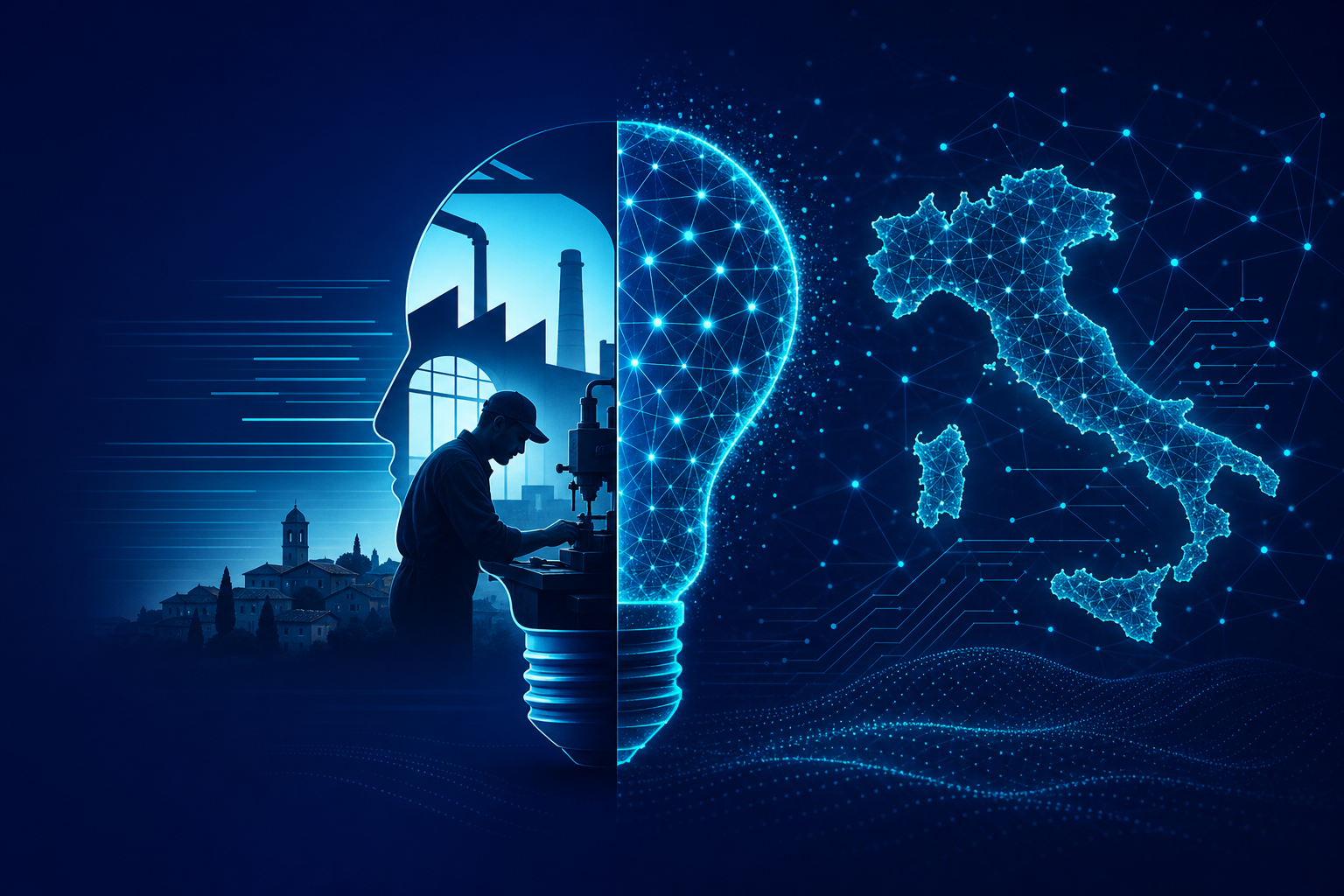
The Hidden Catalyst
Italy's economy has always been built on a foundation that distinguishes it from nearly every other advanced nation: the piccola e media impresa, the small and medium-sized enterprise. With PMI accounting for roughly 99.9% of active businesses and employing about 12.4 million people under the EU SME definition (over 14 million under broader Italian PMI statistics), the PMI is not just an economic statistic — it is the cultural and structural backbone of the country. Industrial districts in Emilia-Romagna, the textile hubs of Veneto, the mechanical clusters of Lombardy: each represents decades of localized craft and collaboration.
But a seismic force is approaching, one that most policy debates in Italy address only indirectly. The widespread adoption of artificial intelligence across knowledge-work and routine-task sectors is not simply automating jobs — it may be creating a class of workers who are both redundant and empowered. For the first time at scale, a former bank clerk, a displaced administrative assistant, or a laid-off logistics coordinator could leverage the same AI capabilities that made them surplus to their employer's needs to start a fully functional, AI-augmented business of their own.
Whether this becomes a large-scale trend is still uncertain, but early signals — solo founders using AI tools, micro-agencies, and AI integration consultancies — are already visible in parts of the Italian economy. If the pattern accelerates, it could carry implications that deserve more open debate: a surge in new PMI registrations that reshapes the relationship between Italy's traditional large enterprises and its decentralized small business ecosystem.
Core thesis (speculative): AI-driven redundancy could create a paradox — the same technology that eliminates some jobs may also provide tools for displaced workers to become entrepreneurs, potentially triggering a wave of new PMIs in Italy. This article explores that scenario; it is not a forecast backed by aggregate startup data.
The Mechanism: How AI Creates Both the Problem and the Solution
The mechanism is elegantly self-reinforcing, and it operates across several overlapping phases.
Phase 1 — Automation of routine work. Italian companies, like their global counterparts, have been deploying AI tools to automate tasks that traditionally employed thousands of workers: data entry, customer service, document processing, scheduling, basic accounting, and quality inspection. Unlike previous waves of automation that primarily affected manufacturing and blue-collar work, this wave hits white-collar and administrative roles — the very sectors where many Italians built their careers and professional identity.
The scale is significant. According to the Politecnico di Milano AI Observatory, Italy's AI market reached about €1.2 billion in 2024 (+58% year on year), though adoption remains concentrated in large enterprises — telecom, insurance, banking, and the public sector — while many PMIs still lag behind. The European Union's most commonly cited barrier to SME investment — the lack of trained labor — is precisely what AI tools are designed to overcome. When a company of fifty employees deploys an AI-powered administrative system, it may accomplish work that previously required a larger back-office team with a smaller staff. The displaced workers are not eliminated because the company is failing; they are displaced because the company is pursuing a leaner operating model.
Phase 2 — Tool democratization. Here is the crucial twist: the AI tools that replace these workers are becoming increasingly accessible, affordable, and powerful. Large language models like Minerva — the first family of LLMs specifically trained for Italian — lower the language barrier that has always hampered Italian entrepreneurs. EU AI Act provisions include reduced penalty caps for startups and SMEs, lowering the regulatory burden. AI factories and shared computing infrastructure, funded under the EU's Apply AI Strategy, democratize access to AI capabilities that once required enormous capital investment.
A displaced customer service manager can now use an AI platform to build a professional website, generate marketing content in fluent Italian, automate invoicing, manage customer relationships, and even handle basic legal compliance — tasks that, just two years ago, would have required a team of specialists or an expensive agency.
Phase 3 — Entrepreneurial conversion. Faced with redundancy, some workers seek new employment. But many others — particularly those in their thirties and forties, with deep domain knowledge of their industry and a network built over years of work — choose to start their own business. Armed with AI tools that level the playing field against larger competitors, they launch PMIs that are leaner, smarter, and more agile than the companies that made them obsolete.
This conversion from employee to founder is the critical threshold. Once it becomes socially visible — when the first prominent cases make headlines — it accelerates through a network effect: displaced workers see former colleagues successfully launching AI-powered businesses and recognize the pathway for themselves.
What This Could Look Like in Practice
Abstract theories are easy to dismiss. Concrete scenarios are harder to ignore. The following profiles are illustrative composites, not documented case studies — but each is grounded in current AI capabilities and realistic Italian business contexts.
Imagine you are Marco, a 42-year-old administrative coordinator at a mid-sized manufacturing firm in Brescia. The company installs an AI-powered ERP system that automates 80% of the procurement, invoicing, and inventory tasks you performed daily. You are offered a voluntary exit package. Instead of looking for another desk job, you launch a boutique supply-chain consulting firm. Using AI tools for market analysis, automated reporting, and client communication, you serve five to eight small manufacturers that cannot afford a full-time consultant but now can afford your AI-augmented services. Your overhead is a laptop, a subscription to AI tools, and your domain expertise — acquired entirely within the company that made you redundant.
Imagine you are Giulia, a 38-year-old customer service representative at a Turin-based insurance broker. The firm deploys an AI chatbot and automated claims processing system. Your role becomes redundant. You decide to start a micro-agency that helps elderly Italians navigate digital bureaucracy — pension applications, tax filings, healthcare registrations — using AI tools to handle the heavy lifting. You market yourself as the human-friendly alternative to faceless digital portals, and your AI assistant handles the form-filling. Within a year, you have 200 clients and revenue comparable to your previous salary.
Imagine you are Roberto, a 45-year-old logistics coordinator at a Naples distribution center. Route optimization AI and automated warehouse management make your position unnecessary. You recognize a gap: small regional food producers — wineries in Campania, mozzarella makers in the region, olive oil producers in Puglia — need help with export logistics and customs documentation. You launch a specialized logistics PMI for agricultural SMEs, using AI to automate customs forms, optimize shipping routes, and communicate with international buyers. Your deep knowledge of the local food economy, combined with AI's operational power, gives you a competitive advantage over larger, less specialized logistics firms.
Imagine you are Elena, a 35-year-old HR specialist at a Milan financial services firm. AI recruiting tools and automated payroll systems replace your department of six people. You spot an opportunity: thousands of Italian PMIs struggle with talent acquisition and compliance. You create an AI-powered HR platform specifically designed for Italian labor law, tailored to the needs of small businesses. Your selling point is simple — you offer the capabilities of a ten-person HR department at a price a PMI can actually pay.
In each scenario, the same pattern repeats: AI creates redundancy, and that redundancy creates capability. The displaced worker possesses three things the new business needs: domain expertise, a network, and the tools to act independently. All three converge at the moment of displacement.
Where the New PMIs Will Emerge
The sectors most exposed to AI-driven redundancy are also the sectors most likely to see an entrepreneurial surge. Several specific use-case categories stand out.
AI-augmented professional services. Accounting, legal assistance, tax consulting, and business advisory services are all highly susceptible to AI automation. A former bank analyst or tax clerk with deep knowledge of Italian fiscal regulation can launch a micro-firm offering competitive tax planning and compliance services, using AI to analyze thousands of regulations and generate compliant documents in minutes. The traditional firms that employed these workers depend on billable hours — a model their AI-empowered former employees can undercut dramatically.
Specialized digital agencies. Marketing, content creation, web design, and social media management are being rapidly transformed by generative AI. A former marketing coordinator can now run a one-person digital agency that produces content, designs campaigns, and manages client accounts at a fraction of the cost of a traditional agency. The Italian market — with its thousands of traditional businesses that need digital transformation but cannot afford agency prices — represents a massive addressable market.
AI operations and integration. As Italian PMIs adopt AI tools, someone needs to implement, maintain, and optimize them. Former IT coordinators, systems analysts, and data entry specialists who understand both Italian business processes and AI capabilities can launch AI integration consultancies targeting the very PMIs that are struggling to adapt. This is a meta-opportunity: the AI wave creates jobs building infrastructure for the AI wave.
Educational and training services. As AI reshapes the labor market, demand for reskilling and upskilling explodes. A former corporate trainer or education coordinator can launch an AI literacy training PMI, helping other Italian workers and traditional PMIs adapt to the new technological environment. The irony is self-reinforcing: the same technology that makes workers redundant creates the demand for teaching others how to use that technology.
Niche AI consulting. Every Italian industry has its own specific challenges, regulatory requirements, and cultural nuances. A former healthcare administrator, an ex-agricultural technician, or a displaced textile industry manager each carries industry-specific knowledge that generalist AI tools cannot replicate. AI becomes the engine; domain expertise becomes the steering wheel. Together, they create businesses that neither could achieve alone.
Three Future Scenarios
Short term (1–2 years): The quiet wave. New PMI registrations could begin to increase in sectors with high AI exposure: administration, customer service, basic accounting, digital marketing. The effect may not yet be visible in aggregate statistics, but industry associations in Lombardy, Emilia-Romagna, and Veneto are already fielding more inquiries about digital and AI-powered business models. Confindustria's 2026 agenda links PMI growth, innovation, salaries, and work with digital technologies and AI — a sign that institutional awareness is growing, even if hard data on AI-driven entrepreneurship remains scarce.
Mid term (3–5 years): The structural shift. If the cumulative effect of AI-enabled entrepreneurship becomes statistically significant, new PMI registrations could rise above historical trends. Traditional Italian large enterprises — particularly in banking, insurance, and logistics — might compete not only with each other but with thousands of new, AI-empowered micro-competitors. Some of these new PMIs could grow into medium-sized companies; most would remain small but collectively represent a meaningful economic force.
Long term (10+ years): The ecosystem transformation. Italy's economic structure, already PMI-dominant, could become even more fragmented and agile. The traditional pyramid hierarchy of corporate organizations might flatten into a network of interconnected micro-firms. GDP growth forecasts — Confindustria's CSC baseline projects about +0.5% for 2026 (assuming the Middle East conflict ends by end-Q1), with employment nearly flat at +0.1% in the number of employed persons — may capture only part of the picture if an AI-enabled PMI wave accelerates beyond current macro projections. The traditional relationship between large Italian enterprises and their supply chains could shift from vertical integration toward a more fluid network of specialized PMIs.
The Technology That Makes It Possible
Several technological trends converge to make this scenario plausible rather than speculative.
Multi-modal AI models are reaching a level of capability where a single tool can handle text generation, data analysis, image creation, spreadsheet management, and code generation — the complete toolkit of a knowledge worker. The convergence of these capabilities into affordable, Italian-language interfaces removes the last significant barriers to individual entrepreneurship.
AI infrastructure democratization through EU-funded AI factories and shared computing resources means that the capital cost of starting a software-centric, AI-powered business has fallen sharply for many use cases — though compliance, domain expertise, sales, and human oversight still carry real costs. A laptop and an internet connection, supplemented by cloud or shared AI infrastructure, replaces what was once a far larger upfront investment in software and specialized staff.
Regulatory evolution is also enabling the trend. The EU AI Act's reduced penalty caps for startups and SMEs, combined with streamlined digital registration procedures across EU member states, lower the friction of starting a business. The EU's own identified barrier — lack of trained labor — is being simultaneously addressed by AI tools that compensate for skill gaps.
Implications: Opportunity and Disruption
The implications of this AI-driven PMI surge cut in multiple directions, presenting both significant opportunities and genuine risks.
Positive implications:
Entrepreneurial empowerment. For the first time, workers with deep industry knowledge but limited capital can compete directly with established firms. AI levels the playing field, transforming domain expertise — accumulated over years of employment — into a competitive moat. This represents a genuine democratization of economic opportunity.
Economic resilience. A more fragmented PMI landscape is inherently more resilient than a concentrated corporate structure. During economic shocks, diversified small businesses adapt more quickly than large hierarchies. Italy's already-strong PMI base becomes even more robust against systemic risks.
Innovation acceleration. New PMIs are typically more innovative than their incumbent counterparts, precisely because they are founded on new capabilities and unburdened by legacy processes. An AI-powered PMI is not trying to improve the old model — it is operating on a fundamentally different cost and capability structure.
Regional rebalancing. AI tools reduce the geographic advantage of large urban centers. A consultant in a small town in Calabria can serve clients in Milan or Munich with the same quality as a firm located in the city. This has the potential to slow the demographic drain from Southern Italy and the islands.
Negative implications and risks:
Disruption of traditional employment pathways. The traditional Italian career model — join a company, learn the ropes, climb the ladder — breaks down when companies automate the very roles that serve as entry points. This creates a paradox: fewer jobs to enter the workforce, but more opportunities to start a business. The net effect depends on how many displaced workers possess both the domain expertise and the entrepreneurial mindset to convert redundancy into opportunity.
Quality and regulation gaps. AI-augmented PMIs operating in regulated sectors (finance, healthcare, legal) may face quality assurance challenges. An AI-powered tax consultant is fast and affordable, but who verifies the accuracy? Regulatory frameworks have not caught up with the possibility of AI-augmented solo practitioners.
Concentration risk in AI tools. While AI tools democratize capability, they concentrate power in the hands of the companies that produce them. If a small number of global AI providers control the tools that empower Italian PMIs, the independence of these new businesses is illusory — dependent on the policies, pricing, and availability decisions of foreign corporations.
Systemic instability for traditional enterprises. Large Italian companies that lose hundreds or thousands of employees to AI automation — and watch those same employees become competitors — face a destabilizing dynamic. The talent drain is compounded by competitive pressure from below.
Conclusion: The Paradox Is the Point
Italy stands at an unusual inflection point. The same technology that may displace workers in administrative and knowledge roles could also give some of them tools to become entrepreneurs. The consequence might not be mass unemployment — but something more disruptive to the status quo: a decentralized wave of new PMIs founded by people whose skills were too expensive to keep on payroll, yet portable enough to sell independently.
This is not a dystopian scenario. It is an evolutionary one — but one that Italy's institutions, from Confindustria to the European Commission, are still largely addressing through the lens of job protection rather than job transition. Policy debates focus on "protecting jobs" when the more relevant question may be "protecting pathways" — ensuring that the transition from employee to founder is supported, not obstructed, by regulation, infrastructure, and social safety nets.
The AI-facilitated PMI surge could represent a significant structural transformation of Italy's economy. The open question is not whether AI will change work, but whether Italy's institutions are prepared for workers who respond by founding businesses instead of waiting for the next employer.
Sources & fact-check notes
- European Commission JRC — Annual Report on European SMEs 2025 (Italy: ~99.9% of enterprises, ~12.5M SME employees). EU SME fact sheet (PDF)
- Il Sole 24 Ore / Politecnico di Milano AI Observatory — Italy AI market €1.2B in 2024 (+58%). Il Sole 24 Ore article
- Minerva LLM family — Sapienza NLP / FAIR / CINECA. minerva-ai.org
- EU AI Act — Article 99(6) SME penalty caps (lower of fixed amount or turnover percentage). Article 99
- Confindustria CSC — Spring 2026 forecasts: GDP +0.5% baseline; employed persons +0.1%. Confindustria publication
- European Commission — AI Factories initiative. EC AI Factories policy page
Corrected in this version: the earlier draft cited "+71,000 additional workers" alongside Confindustria's 2026 GDP forecast — that figure does not appear in Confindustria's macroeconomic outlook (it conflates unrelated statistics). Employment in the baseline scenario is nearly flat (+0.1% employed persons).