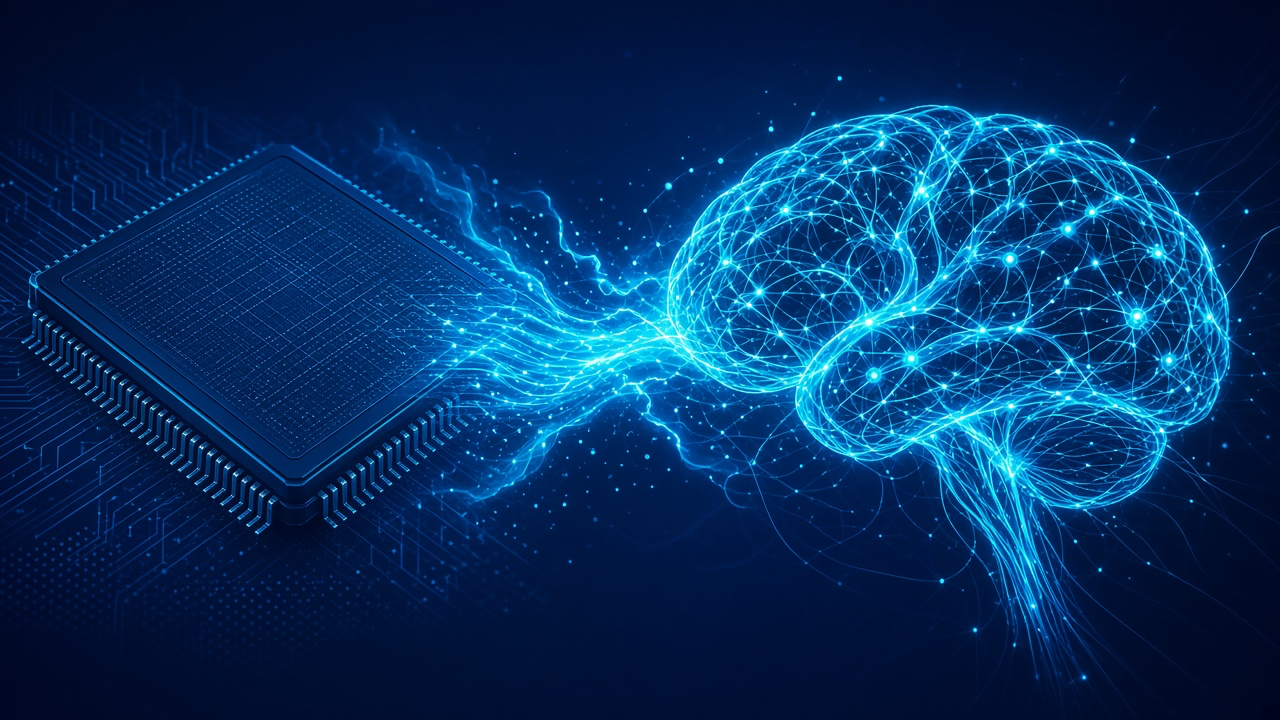
When we hear about artificial intelligence, we almost always hear about the models. The giant language models that can write essays, the image generators that can paint pictures, the assistants that can answer questions. These are the celebrities of the AI world — talked about, debated, and feared in the same breath. But there is a quieter, less glamorous part of the story that matters just as much, and that almost nobody discusses: the chips. Without these tiny slivers of silicon, no AI model could ever do anything. A model is, in a sense, just information — a vast collection of numbers describing how to think. It is the chip that actually brings those numbers to life, turning abstract mathematics into the answers you get on your phone in a fraction of a second. And right now, a revolution is happening in those chips that could change everything about who can afford AI, and how much energy the whole industry uses.
To understand why this matters, we need to understand something surprising: building an AI model and using it are two completely different tasks, and they need two completely different kinds of hardware. The race to make AI smarter has focused almost entirely on the first. But the second — the everyday act of actually running an AI to answer your question, recommend a video, or translate your message — is where most of the cost, most of the energy, and most of the friction really lies. Understanding this distinction is the key to understanding the future of the whole industry.
Why this matters: Running AI is enormously energy-intensive, and the world's data centers are already consuming vast amounts of electricity. New kinds of chips — from custom "inference" silicon to brain-like "neuromorphic" processors — promise to make AI dramatically cheaper and greener. That could decide whether AI becomes a tool for everyone, or a luxury for the few.
What Happened: The Two Kinds of AI Work
To understand the chip revolution, we first need to understand the difference between two things that sound identical but are wildly different: training an AI and running an AI. Training is the process of teaching a model. It is like educating a student, except the student is a mathematical model with billions — sometimes trillions — of pieces of knowledge packed into it. Training happens in enormous data centers filled with thousands of special processors working around the clock, digesting vast amounts of text, images, or data. It takes months, consumes as much electricity as a small town, and costs companies hundreds of millions of dollars. This is the part of AI that makes the news, because it is dramatic, expensive, and visible.
Running an AI — technically called "inference" — is what happens every time you actually use a model. When you ask a chatbot a question, when your phone suggests the next word in a text, when a streaming service recommends a show — that is inference. It happens billions of times a day, on billions of devices, and it needs to be fast, cheap, and energy-efficient. Here is the counterintuitive part: the world is likely to spend far more money and energy on inference over the next decade than it ever has on training. Every new AI feature, every smart appliance, every self-driving car, every personal assistant will need to run AI constantly. The chips that power this everyday use are about to become just as important as the models themselves.
This is why the news of the year is so significant. A major AI company announced a partnership with a chipmaker to design a custom processor built specifically for running AI — not training it. This is a signal that the industry has realized the hardest problem is no longer just making smarter models. It is making those models cheap and energy-efficient enough to run everywhere. And alongside this, a whole wave of new "brain-like" processors is emerging, inspired not by traditional computer design but by the human brain itself.
Practical Examples: What "Running AI" Costs You
The idea that running AI consumes huge amounts of energy can feel abstract. Let me make it concrete with a few comparisons.
Imagine you are having a conversation with an AI assistant. In the time it takes you to read this sentence, the model has performed trillions of tiny calculations to produce its reply. Each of those calculations happens on a processor that uses a little bit of electricity. A single popular AI service, used by hundreds of millions of people asking thousands of questions every minute, can consume as much electricity as a mid-sized city. That is not hyperbole — it is the reality of the infrastructure that already powers parts of your digital life.
Now imagine trying to run a powerful AI model on your phone. Traditional processors simply cannot do it efficiently; they would drain the battery in minutes and overheat the device. This is why most AI today happens "in the cloud," on remote servers you cannot see. But new kinds of chips are changing this. Some can run sophisticated AI directly on your phone, your laptop, or even a small device, using a fraction of the power. This is why your phone is getting smarter on its own, without needing to call a distant server.
Finally, imagine a small business that wants to use AI. Five years ago, this meant paying large companies for access to their models. Today, cheaper chips mean a business could run its own AI locally, paying only for the electricity and the initial hardware. This could democratize AI in the same way the personal computer did — moving power from a few giant data centers into millions of ordinary devices and businesses.
Use Cases Across Industries
The impact of better chips will be felt differently across different fields, and understanding these differences helps explain why the technology is so important.
Consumer electronics. The most immediate impact is on the devices we already own. New chips mean faster, smarter phones, laptops, and smart home devices that can run AI locally without draining batteries or relying on the internet. This is the change you will feel most directly.
Healthcare. Medical devices, from wearable monitors to portable diagnostic tools, need to run AI efficiently and privately. Chips that can process data on the device itself mean faster diagnosis, better privacy, and the ability to monitor patients without constant internet access — a breakthrough for rural or emergency care.
Transportation. Self-driving cars must make life-or-death decisions in milliseconds, using AI that cannot afford to wait for a distant server. Custom chips designed for this exact task are making autonomous vehicles safer and more reliable, and they must use very little power because a car's electrical system has limits.
Environmental monitoring. Sensors that monitor forests, oceans, and farms to detect deforestation, pollution, or crop conditions need to run AI with minimal power, often on solar energy. New low-power chips make these sensors practical for the first time, turning them from lab experiments into real-world tools.
Edge computing. The growing field of "edge" AI — running intelligence right where the data is created, rather than in a central cloud — is being unlocked by these chips. This includes everything from smart factories to real-time translation devices, and it is one of the fastest-growing areas of the entire tech industry.
Future Scenarios: What Comes Next
Short term (1–2 years): We will see AI run much more efficiently on everyday devices. Phones and laptops will get smarter without needing constant internet, and companies will cut their AI costs significantly. Custom chips will become common among the largest tech companies, who can no longer afford to rely on off-the-shelf processors.
Mid term (3–5 years): Brain-like processors will move from laboratories into real products, especially in areas that demand extreme energy efficiency. We will likely see AI running inside everything from cars to farm sensors, powered by chips that use a tiny fraction of the energy of today's processors. The environmental impact could be substantial, as the industry works to make its own growth sustainable.
Long term (10+ years): If the trend continues, we may reach a point where AI runs on so little energy that it becomes essentially free to operate. Intelligent devices could run for years on a single battery or a small solar panel, and the environmental cost of the AI revolution could shrink even as its benefits grow. The question will no longer be "can we afford to run this AI?" but "where can't we afford not to?"
How the Technology Evolved to Reach This Point
The current state of AI chips is the result of a long and complicated story. For decades, computers used processors designed to do many different kinds of calculations well. These were flexible, general-purpose chips — the workhorses of the digital age. But AI does not do many different calculations. It does the same kind of calculation — comparing and combining huge numbers — billions and billions of times. This turned out to be a perfect fit for a different kind of chip, one designed to do one thing extremely well.
The first of these were "GPUs," processors originally built for video games, which turned out to be surprisingly good at AI. This created a boom in a company that had previously been known for graphics cards. But GPUs were a compromise — brilliant generalists forced into a specialist role. Now, companies are designing chips from scratch, optimized for the specific demands of AI. And separately, researchers inspired by neuroscience are building processors that mimic the brain's own structure, using far less energy because, well, your brain runs on about twenty watts — less than a light bulb — while doing far more than any computer.
The Implications: Promise and Peril
The positives. First, cost: better chips could make AI dramatically cheaper, letting more people and businesses benefit. Second, environment: more efficient processors could cut the AI industry's enormous energy footprint, making its growth sustainable. Third, privacy: chips that run AI locally mean your data never has to leave your device, giving you more control over your personal information. Fourth, access: efficient chips could bring AI to developing regions and low-cost devices, closing a growing digital divide.
The risks. First, concentration: designing advanced chips is expensive and complex, meaning only a few giant companies may be able to afford the best ones, concentrating power in too few hands. Second, supply chains: the world's ability to make these chips depends on a small number of manufacturers in a few countries, creating geopolitical and economic vulnerabilities. Third, energy trade-offs: while chips are getting more efficient, the total amount of AI is growing so fast that overall energy use may still rise. Fourth, e-waste: the rapid pace of chip innovation means older devices become obsolete quickly, adding to a growing problem of electronic waste.
Balanced view: The chips behind AI are not a magic solution, but they are a necessary one. No matter how smart our models become, they can only help if they can be run efficiently, affordably, and sustainably. The good news is that the industry is finally paying attention to this problem with the same intensity it has always devoted to making models smarter. The challenge is ensuring that the benefits of this revolution are shared widely, and that the pursuit of smarter AI does not come at the expense of the planet that has to power it.
Conclusion
When we think about the future of AI, it is easy to imagine only bigger, smarter models. But the real revolution may be happening in the tiny chips that quietly run those models billions of times a day. These uncelebrated pieces of silicon will decide whether AI becomes a cheap, green, and widely available tool — or an expensive, energy-hungry luxury reserved for the few. The models get the headlines, but the chips get the job done.
The story of AI hardware is, in the end, a story about accessibility. Every improvement in efficiency means AI can reach more people, more places, and more needs — while costing the planet less. As these chips continue to improve, we may reach a future where running intelligence is as cheap and ubiquitous as electricity is today. The question is not whether this future will arrive, but whether we will build it in a way that benefits everyone. The models are getting smarter. The real test is whether the chips will let everyone share in the intelligence.