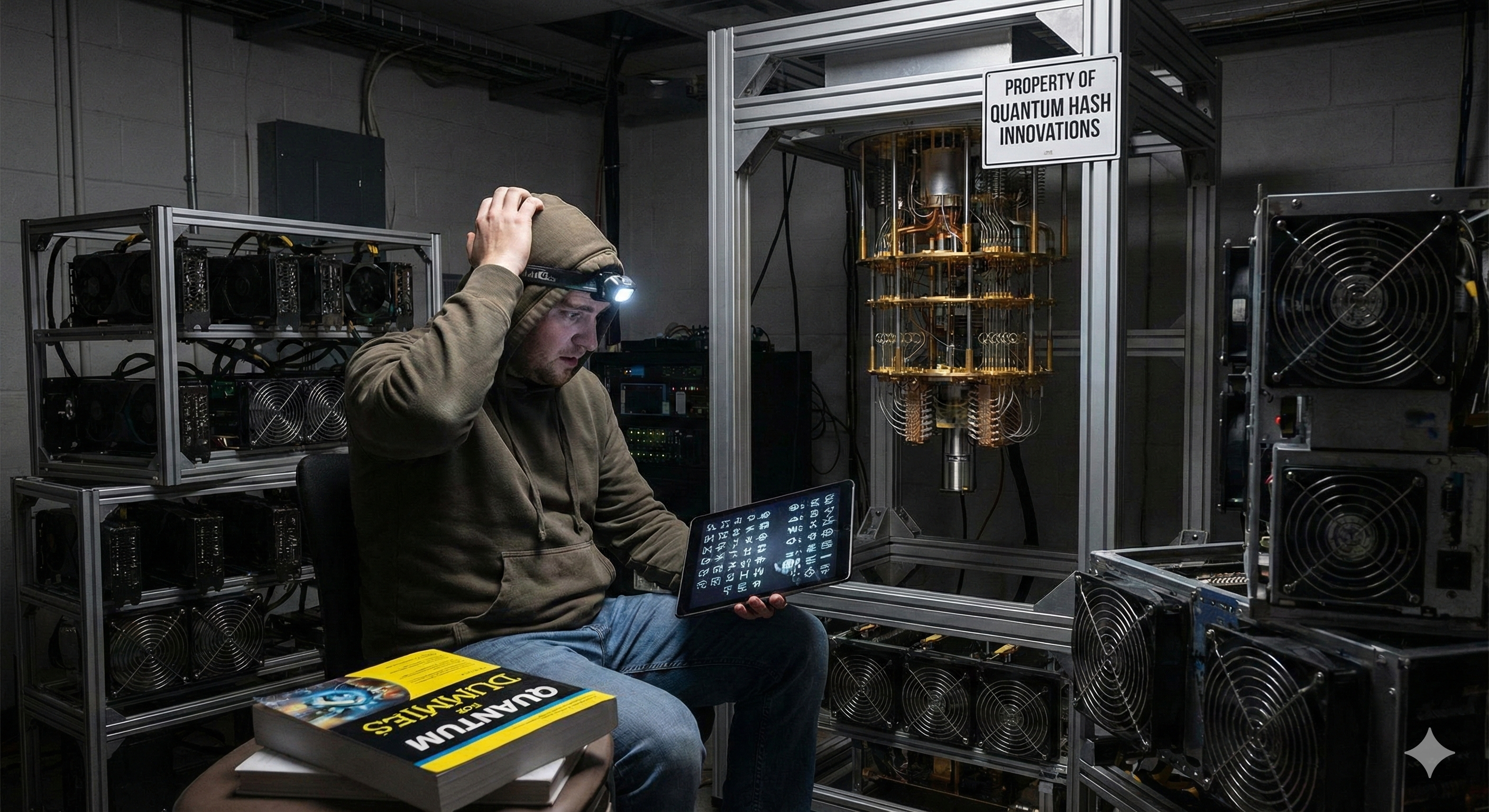
How to Mine Cryptocurrencies in the Era of Quantum Computers
Exploring the intersection of quantum computing and blockchain technology, and how cryptocurrency developers are preparing for the quantum threat
Exploring the intersection of quantum computing and blockchain technology, and how cryptocurrency developers are preparing for the quantum threat
Cryptocurrencies work through blockchain technology, a decentralized ledger of transactions secured by cryptographic algorithms. Mining is the process by which new units of cryptocurrency are created and transactions are validated; miners solve complex mathematical puzzles, known as Proof of Work, to add blocks to the blockchain. Quantum computers pose a threat to this system because their ability to process vast numbers of computations simultaneously could break current cryptographic protections, potentially rendering classical mining ineffective. To counter this, cryptocurrency developers and mining operators are researching quantum-resistant cryptography and longer key lengths to maintain security integrity.
A cryptocurrency operates on a blockchain, a decentralized ledger where transactions are stored in linked blocks. Mining involves specialized computers solving difficult mathematical problems (hash functions) to validate transactions and create new coins. This validation process requires solving an algorithmic puzzle to link blocks securely, and the first miner to solve it earns cryptocurrency rewards. This decentralized system depends on computationally intensive tasks to prevent fraud and ensure trust without a central authority.
The following diagram illustrates how blocks are connected in a blockchain, showing how each block's hash links to the previous block, creating an immutable chain:
The Proof of Work consensus mechanism requires miners to demonstrate computational effort by solving cryptographic puzzles. This process ensures that adding new blocks to the blockchain requires significant computational resources, making it economically impractical for malicious actors to manipulate the blockchain.
How it works:
Every successfully mined block generates new cryptocurrency units as a reward to the miner. This serves two purposes:
In Bitcoin, the block reward halves approximately every four years (a process called "halving"), reducing from 50 BTC initially to 6.25 BTC currently, and will continue decreasing until all 21 million bitcoins are mined.
Mining is essentially the search for a specific hash value under certain constraints, a process based on trial and error. Miners use significant computing power to guess the "nonce," or number used once, to produce a hash that meets the network's difficulty target. Once found, this new block is added to the blockchain and shared across the network. Mining secures the network and regulates the creation of new cryptocurrency units.
Example: In Bitcoin mining, miners attempt to find a nonce that, when combined with the block data and hashed, produces a hash value below a certain target threshold. This target adjusts automatically to maintain an average block time of approximately 10 minutes, ensuring network stability regardless of total mining power.
Quantum computers leverage qubits, which can exist in multiple states simultaneously, allowing them to perform vast parallel computations. This capability means a quantum computer could potentially find the nonce much faster than classical miners, posing a serious threat to the current Proof of Work validation. However, due to qubit instability and error margins, a quantum computer cannot yet deterministically break cryptographic hashes as proposed. To maintain security, blockchain protocols are exploring quantum-resistant algorithms and increasing key sizes to extend the quantum computational effort required indefinitely.
While quantum computers theoretically could break current cryptographic systems, practical quantum computers capable of such feats are still years away. Current quantum computers face significant challenges including:
Cryptocurrency developers are investigating post-quantum cryptography—algorithms designed to be secure against quantum attacks. These include lattice-based, hash-based, and multivariate quadratic equations cryptography. Miners and blockchain networks are preparing upgrades to integrate these quantum-safe measures to protect transaction validation and mining processes. Meanwhile, extending key lengths is another defense strategy aimed at exponentially increasing the qubits required to break current codes, making a quantum breach practically infeasible for the foreseeable future.
This approach ensures that while quantum computing presents a significant future challenge, the cryptocurrency ecosystem is actively working to adapt and secure the technology underpinning digital currencies against it, preserving trust and decentralization.
Several blockchain projects are already pioneering quantum-resistant technologies to address the emerging threat from quantum computers. One notable example is the Quantum Resistant Ledger (QRL), a layer-1 blockchain launched in 2017 explicitly designed to be secure against quantum attacks. QRL employs the eXtended Merkle Signature Scheme (XMSS), a hash-based, post-quantum secure signature method that has received approval from the U.S. National Institute of Standards and Technology (NIST). This scheme uses one-time signatures and reusable addresses to provide long-term security against quantum adversaries. QRL also implements a decentralized proof-of-stake consensus mechanism and supports quantum-resistant tokens and on-chain messaging, aiming for a comprehensive quantum-secure ecosystem.
Ethereum, while not originally built with quantum resilience, is actively exploring integrating post-quantum cryptographic techniques such as hash-based signatures and lattice-based cryptography. Ongoing research and testing aim to enable Ethereum to gradually adopt quantum-safe cryptographic primitives in its future protocol upgrades, ensuring its smart contracts and transaction validations remain secure.
Bitcoin is also evaluating potential paths toward quantum resistance by considering upgrades like Taproot and exploring the possibility of incorporating quantum-safe signature schemes. These efforts focus on enabling a smooth transition that supports both classical and quantum-resistant cryptography, maintaining network security without disrupting the existing decentralized structure.
One of the promising methods to defend blockchain signatures against quantum attacks is hash-based cryptography. Unlike classical cryptographic algorithms such as ECDSA, hash-based signatures rely solely on secure cryptographic hash functions, which are believed to resist quantum adversaries.
A simple conceptual example is the Lamport One-Time Signature scheme, which uses pairs of random keys and hashes for signing messages. Though not practical for full-scale use, it illustrates the principles underlying many quantum-resistant schemes.
The following Python example demonstrates the basic principles of hash-based quantum-resistant signatures:
import hashlib
import os

def generate_keypair():
    """Generate a Lamport key pair of 256 pairs of random 256-bit strings."""
    private_key = [(os.urandom(32), os.urandom(32)) for _ in range(256)]
    public_key = [(hashlib.sha256(priv0).digest(), hashlib.sha256(priv1).digest()) for priv0, priv1 in private_key]
    return private_key, public_key

def sign(message, private_key):
    """Sign the message by revealing parts of the private key based on message bits."""
    message_hash = hashlib.sha256(message).digest()
    signature = []
    for i in range(256):
        bit = (message_hash[i // 8] >> (7 - (i % 8))) & 1
        signature.append(private_key[i][bit])
    return signature

def verify(message, signature, public_key):
    """Verify signature by hashing each revealed key and comparing to public key."""
    message_hash = hashlib.sha256(message).digest()
    for i in range(256):
        bit = (message_hash[i // 8] >> (7 - (i % 8))) & 1
        if hashlib.sha256(signature[i]).digest() != public_key[i][bit]:
            return False
    return True

# Example usage:
msg = b"Important blockchain transaction"
priv, pub = generate_keypair()
sig = sign(msg, priv)
print("Signature valid?", verify(msg, sig, pub))
This example demonstrates generating a quantum-resistant key pair, signing a message, and verifying the signature using only cryptographic hashes. Real blockchain quantum-resistant schemes build on similar principles but use optimized and scalable approaches such as XMSS or SPHINCS+.
While the Lamport scheme demonstrates the concept, production systems use more advanced schemes:
As quantum computing technology advances, the cryptocurrency ecosystem is proactively preparing for the quantum era. The transition to quantum-resistant cryptography represents one of the most significant security upgrades in blockchain history, requiring careful planning and community consensus.
Key considerations for the transition include:
The intersection of quantum computing and cryptocurrency mining represents one of the most fascinating and critical challenges facing the blockchain ecosystem today. While quantum computers pose a theoretical threat to current cryptographic systems, the cryptocurrency community is not standing still. Through proactive research, development of quantum-resistant algorithms, and strategic upgrades to existing blockchains, the industry is positioning itself to maintain security and decentralization in the quantum era.
The transition to quantum-resistant cryptography is not a matter of if, but when. Projects like QRL have already demonstrated that quantum-safe blockchains are not only possible but practical. Major cryptocurrencies like Bitcoin and Ethereum are actively exploring post-quantum solutions, ensuring that the digital currency revolution will continue to thrive even as computing technology evolves.
For miners and cryptocurrency enthusiasts, understanding these developments is crucial. The shift to quantum-resistant algorithms will require adaptation, but it also represents an opportunity to participate in building a more secure and resilient financial infrastructure. As we stand on the threshold of the quantum computing age, the cryptocurrency ecosystem's proactive approach to security demonstrates its maturity and commitment to long-term viability.
Ultimately, the story of cryptocurrencies in the quantum era is one of resilience, innovation, and adaptation. Just as blockchain technology disrupted traditional finance, quantum-resistant cryptography will ensure that digital currencies remain secure and trustworthy for generations to come. The future of money is being written today, and it's being written with quantum security in mind.
The next decade will be critical for quantum-resistant cryptography adoption. As quantum computers become more powerful and accessible, the window for transitioning existing blockchains will narrow. However, the groundwork being laid today—through research, testing, and early implementations—ensures that when quantum computers become a practical threat, the cryptocurrency ecosystem will be ready.
For developers, miners, and users, staying informed about these developments and participating in the transition will be essential. The future of decentralized finance depends on our collective ability to adapt and evolve, and the quantum challenge is just the latest chapter in the ongoing story of blockchain innovation.
If you need additional specific information about quantum computing, cryptocurrency mining, or quantum-resistant cryptography, please send an email.