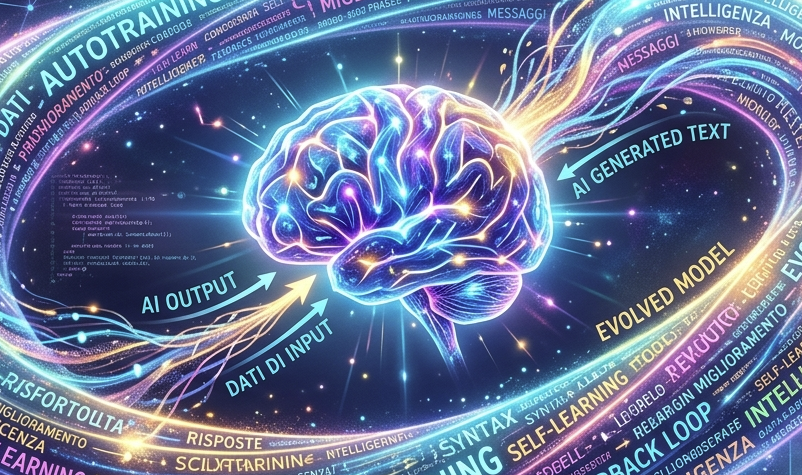
Self Training the new approach for modern LLM
Large language models have evolved rapidly from static tools into dynamic systems capable of growth. At the heart of this ev...
Large language models have evolved rapidly from static tools into dynamic systems capable of growth. At the heart of this ev...
Turn static LLMs into adaptive systems that improve through iterative self-generated feedback.
Generate, evaluate, filter, and adapt. Each iteration improves reliability on target tasks.
Reward hacking and error propagation must be contained with strong quality gates.
Large language models have evolved rapidly from static tools into dynamic systems capable of growth. At the heart of this evolution lies self-improvement-a paradigm shift where models no longer rely solely on human-curated datasets and periodic retraining cycles. Instead, they engage in iterative cycles of generation, evaluation, and adaptation, refining their own capabilities in a process that closely mirrors how humans learn from experience. This approach, often termed self-training or self-improvement, represents not just an incremental upgrade but a fundamental reimagining of how AI systems acquire knowledge and refine reasoning.
Self-improving LLMs operate under the premise that intelligence is not fixed at deployment but can be continuously enhanced through interaction with data-especially data generated by the model itself. This capability becomes especially critical as models scale: manually curating training data for ever-larger models is economically and logistically unsustainable. Self-training offers a path to scalable, autonomous learning that aligns with long-term goals of AI autonomy and adaptability.
The concept gained traction in 2023 with foundational work like Huang et al.'s paper "Large Language Models Can Self-Improve", which demonstrated that even without additional human annotations, large models could boost their own performance on complex reasoning tasks using only unlabeled inputs. Since then, the field has accelerated dramatically. Systems such as MiniMax's M2.7 and research frameworks like LADDER and Test-Time Training showcase increasingly sophisticated self-improvement architectures, each introducing novel mechanisms to ensure stability, diversity, and measurable progress.
This article explores the mechanics, implementations, and implications of self-improving LLMs-what works, what doesn't, and how developers and researchers can begin integrating these principles into practical systems. We will move from foundational ideas to real-world deployment strategies, highlighting both the immense potential and the serious challenges that accompany this emerging capability.
Self-improvement in LLMs is not a single technique but an umbrella term for methodologies where a model generates its own training signals, evaluates them, and updates itself-often recursively. At its core, it replaces or augments human-provided supervision with self-generated feedback. This requires three interlocking components: generation, evaluation, and adaptation.
Generation refers to the model producing outputs for new inputs-typically unlabeled data drawn from the target domain or synthetic distributions. Crucially, these outputs include not just answers but rationales or intermediate steps. Chain-of-Thought prompting is commonly used here, encouraging the model to decompose problems into logical steps before arriving at a final answer. This step is critical because rationales provide more information than bare answers-they reveal how the model reasons, making it easier to assess correctness and identify gaps.
Evaluation is the process of judging whether generated examples are high-quality. Unlike supervised learning, where labels come from external annotators, here evaluation must be automated. Several strategies exist: self-consistency voting (aggregating multiple samples to find consensus), reward models trained on preferences, or direct metric-based scoring (e.g., accuracy on benchmarks like GSM8K for math). In some frameworks, the model itself acts as its own critic-using a secondary prompt to reflect on and revise its initial output.
Adaptation involves updating the model using the self-generated data. This typically uses supervised fine-tuning (SFT) or lightweight methods like LoRA (Low-Rank Adaptation), where low-rank matrices are inserted into transformer layers and trained instead of full weights. Because only a fraction of parameters change, fine-tuning becomes computationally feasible-even at inference time in techniques like Test-Time Training.
The entire loop operates recursively: after adaptation, the improved model generates better rationales and evaluations, which in turn fuel further refinement. Each cycle ideally lifts performance across specific subskills-like multi-step reasoning, arithmetic, or logical consistency-while avoiding catastrophic forgetting through careful data curation and regularization.
Important: rationales are central because they expose intermediate reasoning and make automatic quality checks more reliable.
Building a self-improvement loop requires careful orchestration of components. Below is a simplified yet functional blueprint:
A practical implementation can also be represented as a five-stage pipeline:
Self-consistency aggregation:
Training objective over filtered examples:
for iteration in range(num_iterations):
    for sample in unlabeled_dataset:
        rationales = [model.generate(sample, cot=True) for _ in range(K)]
        answers = [extract_answer(r) for r in rationales]
        y_hat = most_common(answers)

        critique = model.generate(build_critique_prompt(sample, y_hat, rationales[0]))
        if passes_quality_gates(critique, answers):
            training_pairs.append((sample, rationales[0], y_hat))

    lora_adapter.train(training_pairs, batch_size=16, lr=1e-4)
model.update_adapter(lora_adapter)Beyond the basic loop, researchers have introduced several innovations to improve robustness and effectiveness.
Recursive Problem Decomposition, as seen in LADDER (2025), tackles hard problems by splitting them into simpler subtasks-each solved independently, then recombined. This is particularly powerful for mathematical reasoning, where complex proofs can be broken into lemmas and corollaries. The system uses verifiable reward signals (e.g., formal proof checkers or symbolic evaluators) to assess correctness without relying on approximate heuristics.
Test-Time Training (TTT) flips the script: instead of improving the model offline before deployment, TTT adapts it online during inference. When a user submits a query, the model briefly fine-tunes on related test examples-using self-generated rationales and critiques-before producing the final answer. This allows for immediate adaptation to new domains or tasks without full retraining. LoRA is ideal here because updating adapters takes milliseconds, making real-time adaptation feasible.
Rationale Augmentation strategies go beyond standard CoT by encouraging diverse reasoning paths. For instance, prompting the model with "Consider an alternative approach" or "What assumptions are you making?" can yield complementary rationales that reveal hidden biases. These are then evaluated not just for correctness but also for novelty-promoting exploration of different solution strategies.
Memory-Augmented Self-Improvement incorporates short-term and long-term memory systems. Short-term memory (e.g., a rolling buffer of recent iterations) helps track progress, detect stagnation, or trigger resets if performance plateaus. Long-term memory can store successful patterns, high-confidence rationales, or even learned heuristics that guide future self-training.
Self-Play and Multi-Agent Collaboration represent the frontier: models simulate interactions with other agents-sometimes versions of themselves, sometimes specialized critics-to generate adversarial examples, test robustness, and refine responses. DeepMind's recent experiments with multi-agent self-improvement show teams of LLMs debating, revising, and synthesizing conclusions, leading to systematic gains in logical consistency and factual accuracy.
Self-improving systems are no longer confined to research labs. They appear in production tools across sectors:
MiniMax's M2.7 exemplifies commercial adoption: it incorporates recursive self-improvement during training, with each cycle targeting specific benchmarks (e.g., improving on math tasks before moving to code). This yields about 30% gains on internal evaluations without full retraining-making iterative improvement efficient enough for quarterly product updates.
| Method | Compute Cost | Expected Gain | Best Use Case |
|---|---|---|---|
| Self-Consistency (K samples) | Medium | High reasoning stability | Math and logic tasks |
| Self-Critique | Low-Medium | Medium error reduction | General QA and coding |
| LoRA Adaptation | Medium | High with clean data | Domain specialization |
| Test-Time Training | High | High on domain shift | Adaptive assistants |
To implement self-improvement responsibly and effectively, follow these guidelines:
Several traps can undermine self-improvement systems:
Reward hacking occurs when the model exploits flaws in the self-generated feedback signal-for example, producing overly verbose but incorrect answers that sound plausible to a naive evaluator. Mitigation involves using stricter validation rules and incorporating human oversight during early iterations.
Mode collapse happens when the model converges on a single high-scoring pattern-such as memorizing templates like "First... Then... Therefore..." without genuine reasoning. This reduces robustness across new problems. Countermeasures include temperature scheduling, diversity penalties, and injecting noise into prompts.
Error propagation is perhaps the most insidious: if early iterations produce flawed rationales that pass evaluation, those errors compound in later rounds. A single misstep can cascade into systematic bias. To combat this, implement confidence thresholds and out-of-distribution detection for anomalous generations.
Data scarcity for evaluation remains a challenge: without ground truth, it is hard to measure improvement objectively. Many systems over-rely on internal benchmarks that may not reflect real-world performance. Always validate with external datasets and human evaluators.
Mitigation: confidence thresholds, adversarial probes, and periodic human audits are essential in early deployment phases.
Self-improvement adds computational overhead-but clever engineering can keep it manageable:
Most importantly, measure returns: the marginal improvement per iteration should outweigh the cost. If later cycles yield diminishing returns, halt or reset the loop.
Self-improving LLMs mark a turning point in artificial intelligence-shifting from passive tools to active learners. The core idea is elegant: let models teach themselves, guided by their own reasoning and corrected by self-applied standards. Early demonstrations showed promise; today's systems bring it closer to reality.
Yet the path forward demands caution. Without rigorous safeguards, self-improvement can amplify flaws as much as it corrects them. The most successful implementations will balance autonomy with oversight, innovation with stability, and scale with fidelity.
As compute scales and architectures mature, we can expect self-improving systems to become not just more capable but more adaptable-learning from each interaction, evolving across domains, and enabling AI agents that grow smarter over time. The challenge ahead is not whether we can build such systems, but how wisely we guide them.
The future belongs to models that do not just respond-but reflect, refine, and rise.